But If Not – by J Stuart Holden

Introduction  But If Not

The following article  was the inspiration for my sermon that can be viewed at this link

But If Not 

A sermon by John Thatcher

The original article  was published as a small booklet and written from Keswick, a town in the Lake district of the UK. It was written by Rev J Stuart Holden, Vicar of St. Paul’s in London. It was apparently delivered at the conclusion of the Keswick retreat or Bible School for evangelical pastors of Protestant faiths. It addresses disappointed Christianity, to those whose lofty spiritual ambitions may not be realised.

According to Wiki –

In 1875, the Keswick Convention began. It was the drawing together of ministers and people from different Protestant and Evangelical backgrounds for the purpose of ministering and sharing the teachings of The Deeper Life. The Keswick Convention has had a profound effect on the church from the late 1800’s to the middle of the 1900’s. The earliest part of the movement saw the greatest effect. Well-known ministers such as F. B. Meyer, Evan H. Hopkins, H. W. Webb-Peploe, H. C. G. Moule and many others were consistent speakers at the annual conventions. There were also guest speakers which had a profound influence on the movement itself, such as Andrew Murray and J. Hudson Taylor. The most well-known missionary from the movement was Amy Wilson Carmichael. Beginning in 1892 the messages of the annual conventions were printed in annual volumes entitled “The Story of Keswick”, the first two years, and “The Keswick Week” in the years following. These books are difficult to come by and are usually in very rough condition.

Keswick
Keswick, U.K.
holden
                 Rev J Stuart Holden

But If Not

Rev J Stuart Holden, 1914

I suppose it is safe to say, that the majority of us in this tent, and especially those who have been brought, during these past days, to the adoption of new attitudes of surrender and faith toward our Lord Jesus Christ, are taking away with us in a very few hours, great expectations. We have been led by the proclamation of God’s truth and the illumination of His Spirit in these gatherings, to expect large changes in our experience, large renewals of strength and grace, large openings of fruitful service; and with these expectations we are leaving this this mount of vision to get back to the valley of duty.

I want to speak as simply – and God knows I want to speak as tenderly – as may be to those who, in the days to come, may not realise these expectations; to those who not many days hence are going to be sadly disappointed because their experience does not reach out to their expectation. I want that each one of us shall see that God has larger meanings in life then we are now able to read, that God has larger answers to our prayers then we are able to anticipate, that God has a thousand ways of fulfilling His promise in human lives that trust in Him; that so forewarned by this knowledge of God’s wondrous greatness and transcendence, we may be fore armed against the perils of disappointment and forearmed against that disheartening of soul which makes our hearts fruitful ground for the most noxious seed evil can sow there.

Therefore, I want to speak to you tonight on three words as you find them in Daniel 3:18. Without reading the whole story, let me read with you from the 16th verse, which will recall the incident of which this is part to your minds.

16 “Shadrach, Meshach, and Abednego, answered and said to the king, O Nebuchadnezzar, we are not careful to answer thee in this matter.  17 If it be so, our God whom we serve is able to deliver us from the burning fiery furnace, and He will deliver us out of thine hand, O king.  18 But if not, be it known unto thee, O king, that we will not serve thy gods, nor worship the golden image which thou hast set up” (Dan 3:16-18).

You remember the story of course. Challenged not to worship God at all, challenged to bow down to the popular idol, challenged to join the fickle multitude in acclaiming an earthly king – to the degradation of the King of their hearts, with a burning fiery furnace in front of them, as the only alternative to obedience, this is the answer of the three Hebrew children. “Our God is able to deliver us! More than that, our God will deliver us! More than that, if He does not deliver us, we are still not going to worship your idol! If He does not deliver us, our faith is not at an end. If He does not deliver us, our resolution is entirely unshaken. We still believe God.”

Now it may be for you and me that the experiences we have sought here, the prayer we have offered here, the hopes that have been aroused here, are none of them going to be realised just in the way we have imagined. It may be that you who have claimed a deliverance which you have seen as part of God’s plan for your life, are going to find that God works by human cooperation with His divine spirit and that your way of deliverance is along a Via Dolorosa. It may be that you my brethren, who have claimed a Pentecost from God, are going to find that it leads you not to a revival, but to a tremendous opposition.

It may be that in your church and mission you are not going to see a great in gathering of souls at all, but a determined revolt of worldly Christians and church officers. It may be that from Keswick you are going into a pathway which is dark with the mysteries of God’s dealing with you. And let me say to you here, that if your faith has not got an alternative, you are going to get worsted. And if you are overthrown because of the things which, in some shape or form you are bound to meet, then the world which is looking on, which is taking its measure of Jesus Christ from the loyalty and fidelity of your witness to Him, is going to be stumbled. Blessed be God, our gracious God, who teaches our hands to war and our fingers to fight, who is our hope and our fortress, our battle-axe had our deliverer! Blessed be God, who speaks to forewarn us ere we go from this place into the unknown life of peril and danger and opposition! Let us see to it that our faith has an alternative to our present expectation. Blessed is the man who goes down from Keswick saying something of the same thing that these three Hebrews said to the great king who vaunted himself against God: “We will not serve thee; we will not bow down to thine image; even if God does not do for us what we have trusted Him to do.” Oh God, give us faith like this!

Do not think that this is faithlessness on the part of these men. Read their splendid protest; “Our God is able, and He will; but if He does not, we still recognise His will as entirely supreme. If He does not, we still recognise God as greater than our hearts and all our imaginings. If He does not do just what we thought He was going to do, we still believe, though we may have no evidence of sense to support our faith”. This is the faith which accepts God’s will not merely with equanimity but with positive enthusiasm. This is the faith which relates itself not only to the commands of God, but to His contradictions; and if you and I go on with Him we shall find that pathway to be one of constant contradiction. Christ, my leader may contradict my conceptions; Christ, my teacher may contradict my impulse and my aims; Christ, my master will bring all things within me into conformity to His holy purpose. Oh, this is not faithlessness, it is faith which says, “but if not, my course is already clear; if not, my determination has already been made; if not, my resolve is entirely unaltered for it has been made in the conscious presence of God, and on the warrant of His own sure word.”

I should like to say here that it is by such contradictions that God teaches us in ways which otherwise were impossible either to Him or to us. There are words which I often read to my enlightening and comfort, the uplift of which I should like to share with you now:

“If all my years were summer, could I know

 What my Lord means by His ‘made white as snow?’

If all my days were sunny, could I say

 ‘in His fair land He wipes all tears away?”

If I were never weary, could I keep

close to my heart, ‘he gives His loved ones sleep.’

Were no graves mine, might I not come to deem

the life eternal but a baseless dream?

My winter, yea, my tears, my weariness,

Even my graves, may be His way to bless.

I call them ‘ills’, yet that can surely be,

 nothing but love that shows my Lord to me!”

In the days which lie ahead of each of us, with their perplexing experiences, remember that His meanings of life are essentially larger than ours. It will fill our hearts with peace and put stability into our lives to be able to say: “but if not Lord, I still trust Thee; and if not, I am here as truly Thine as ever I was; as truly Thine in the darkness of London, of the slums, of the mission field, of the unsympathetic home, as truly Thine, my God, in the darkness as I was Thine in the light at Keswick. But if not” -!

This alternative to disappointed faith tests the entire quality of the man who professes the faith of God. I know the man – I have him in mind tonight – who, being disappointed in his experience, nervously begins to pity himself; the man to whom self-consequence is everything. When God contradicts his expectation and longing, his faith is staggered, and his backsliding begins. I know the man who is willing to accept a shallow answer to a great question; the man to whom disappointment becomes disbelief; the man who measures God in the tiny scales of his own self-consciousness. Many such have gone from Keswick to be utterly disheartened, utterly despondent, and ultimately a deserter. For there is a subtle interaction in the life of every one of us of courage and conscience. The man who does not stand firm with God and for Him, loses his power of vision, and with that much else goes also.

On the other hand, I know the man who has learned to say courageously with these three Hebrews, “But if not – there shall be no deviation from my duty; its dominance shall be entirely unaffected in my life. But if not – if no ecstatic joy fills me, if no revival results appear in my work, I mean to go on and do the next thing. If I do not get the sunshine in all its full-orbed light upon my life, I mean to follow the gleam which I have already seen. If I cannot see the distant scene, I can at least see one step ahead. God has given me enough light to walk by; and in any case, I’m going on with His work. There shall be no cessation of hostility to evil, no backing out of the conflict with the forces of the devil in the world. There shall be no lowering of my aim, even if I should be conscious of disappointment. By the grace of God, forgetting the things that are behind, I press on toward the mark for the prize. Even if the battle seems to be going against me, there shall be no desertion of the colours.”

For instance, here is a businessman who has come to a determination to seek first the Kingdom of God in his business, with a certainty that all things else shall be added to him. And he finds not additions but subtractions! He finds that his profits are not greater but actually less each year. He finds just what we have been reminded of tonight, that the pathway of the cross is no sentimental emotional thing to sing about; but that the cross is heavy and the way is narrow and his position inexpressibly difficult. For that man, real blessing is bound up in the attitude which says: “But if not!  I do not intend to haul down the flag. I do not intend for a moment to desert my Lord. For I can never unsee what I have seen in Him: I can never unlearn what I have learned from Him: and I can never lose that which He has begun to work in me. Therefore, be the consequences of my fidelity what they may, I am going on with God.”

After all, if you have the real faith of a child as you leave Keswick, in consequence of God’s drawing near to you here, it is founded not upon a subjective experience, but upon God Himself. Our faith does not stand in the wisdom of men. Our faith does not stand in the memory of any emotional thrill which may have come, lifting us up to a higher plane in this place. Our faith does not rest upon anything that is visible, but upon that which is within the veil, where Jesus is. Therefore, in the calm confidence of a child, I may say with these three Hebrew children; “I am expecting God to do wonderful things for me, I am expecting God to breakdown iron gates before me, and to beat down my foes all around me. I am expecting God to give me great and wonderful power in His work, manifested by souls gathered in and breaking forth of blessings all round. But if He does not, I am still going on with Him, persuaded that He does all things well. His wisdom is my sheet-anchor and His faithfulness my stay.”

Now let me point out to you that God’s response to this spirit is to do a bigger thing than we trust Him for, not a smaller. These men said “our God is able to deliver us from the fire. What do we care about your furnace heated 7 times though it might be? It does not affect us in the slightest. It does not even make us perspire with fright. We are entirely calm in front of it. Our God is able and He will deliver us from it.” But God did a far bigger thing for them then they thought He would do. He did not deliver them from the peril at all, but He delivered them in it, which is an infinitely greater thing. He did not affect their escape from the furnace, but He gave them an experience of fellowship in the furnace such as they had never dreamed of. For God’s angel came to walk with them in the flame. I wonder what they talked about, the faithful God and His faithful servants? That they did talk together we may be very sure, and that those three heard words there which it is not lawful for men to utter or to imagine. One thing is certain: They learned more in that furnace with God’s angel than they had ever dreamed it possible for men to know of God. That is the kind of thing God does for the men who have this spirit. They said: “He is going to check your hand, O King”. But He did not do it at all – he did something greater. He changed the King’s heart and brought him to a knowledge of His almighty power and grace. Oh! great though your expectations are, they are not great enough. Great though the promises are to your conception tonight that conception is not nearly great enough. God is going to do an infinitely larger and a more influential thing in our lives if we will stand with Him.

Again, I would remind you that this is not an isolated instance of this spirit and the divine response to it, for we find the principle at least running right through the word of God. Let me give you an illustration or two ere I close. Elohim said to Abraham: “Take now thy son, thine only son Isaac”; so he took him, and together they mounted the hill. I hear the boy saying to the father: “Father, here is the wood for the sacrifice, but where is the lamb?” And I hear Abraham say to him, and to his own heart also: “My son, God will provide himself a lamb. But if not, the programme is going to be carried out. But if not, there is still going to be a sacrifice. My purpose is undeterred; my obedience to God is unaltered: my devotion to His will is entirely unmoved, even if He does not provide a lamb, and I have to put my son to the knife and to the fire”. That is the secret of Abraham’s fruitfulness – his faithfulness; and that is the secret of God’s blessing to the nations through this man.

I see it again in a man who has lost everything. His home is gone, his friends are against him, his health is undone. He sits there mourning; and yet beneath the mourning there is a note of triumph. God shall bring me forth to the light, and I shall behold him. Then he says in effect, “But if not, though he slay me, yet will I trust him.” Even if He does not bring me out to the place where I may behold His face in righteousness, I shall still trust him. I know that my Redeemer liveth.”

I see it in another man. He is in prison – a man persuaded of Christ’s identity and mission; a man who stands for the most complete self-effacement this world has ever seen; who cried to others: “behold the Lamb of God”, and rejoiced when his own disciples left him to go with Jesus; a man who knew the power of God in his life, for he was filled with the Holy Spirit from his birth; a man who saw in Jesus the great Baptizer with the Holy Spirit and with fire; and a man whose faithfulness was put to such severe test in the prison house on the shores of the Dead Sea as you and I have never known and never can know. He sent his disciples to Jesus, to the one who said He had come to liberate the prisoners; and yet here is one of his loyal friends whom He does not liberate. Here is the one whom He has proclaimed as the mighty Messiah of God, but who seems so slow at coming to the victorious side of his work. John sends his disciples to Jesus with the query: “Master, after all, have I been mistaken? Art thou He who should come?  I thought you were, but if you are not, I am still going on to look for another: for the promises of God cannot be broken”.

I think of Paul too. All those wonderful and magnificent declaration of Paul’s faith. Listen to them above the howling of The Tempest. “I am persuaded, that neither death, nor life, nor angels, nor principalities, nor powers, nor things present, nor things to come, nor height, nor depth, nor any other creature, shall be able to separate us from the love of God, which is in Christ Jesus our Lord”! “In all these things we are more than conquerors through Him that loved us.” “Thanks be unto God which always causes us to ride in triumph in Christ!”. And he ended where? In a prison! Not in a great experience of triumph and conquest but in a prison, chained to two Roman soldiers. Surely Paul had this “if not” spirit in him. If you want to read its expression, turn to his prison epistles; turn to the words that came from his heart in that captivity in Rome, and you will see the indomitable courage of a man who was filled with the spirit of God.

But, before I close, there is someone higher; greater than Abraham, and Job, and John, and Paul; there is the blessed one himself. Away yonder in the garden He cries: “Father, if it be possible, let this cup pass from me. But if not, thy will be done”. That is the spirit which made the world’s redemption an accomplished fact. that is the spirit in you and me which will invest our lives with redemptive value, as we go out from the throne of God down to the lowest gutter of sin, to do the work of the Redeemer. This is the spirit, and the only spirit, which ensures victory beyond anything we can conceive.

So, as we turn from Keswick, may God make this your spirit and mine, in view of all that the future may hold, in view of all the mystery that may becloud your pathway, in view of all that may stagger you for a moment as God’s greatest thoughts are brought into conflict with your own inferior and unworthier thoughts concerning His purpose. When your prayers, instead of being speedily answered, are delayed of answer; when those things you thought God must do for you, He still keeps you waiting for, may God help each one of us to say in some such words as these – “But if not.”

“I’ll follow Thee, of life the Giver;

“I’ll follow Thee, loving Redeemer:

“I’ll follow Thee, deny thee never:

“By thy grace, I’ll follow Thee.”

I will say just one more thing, and it is that the world is perfectly helpless before that kind of Christian. The world is positively powerless before the man who actually laughs at its threats, because he knows what they are worth, and who goes into the fire for God with a song in his heart. It cannot light a fire, however vehement is flame, that can do more than burn up the man’s bonds and bring him into greater liberty as he sings:

“Across the path of nature leads on the path of God;

Not where the flesh delighteth, the feet of Jesus trod.

What though the way be lonely, and dark, and bleak, and lone,

Though crags and tangles cross it

Praise God we will go on!”

And as the world is helpless before a man of that kind of faith, God cannot be otherwise than truly faithful to such a one. Therefore, as in a few minutes we shall go out into the night, and shall certainly never all meet until Jesus comes back again, would it not be an infinite blessing to us to bring our Keswick week to a close by solemnly, gladly reaffirming this same sure note in the presence of God now: “Oh God I am expecting so much from You. I am expecting you to do such wonderful things. My God, I am expecting you to make all things new with one word of your power. But if not, if you keep me waiting, if you discipline me into patience, and correct my misconceptions by your wisdom, I here and now covenant with you, my Lord that I will stand by you. I here and now covenant, my Lord, in all the naked sincerity of my soul, that I am Thine utterly and absolutely, down to the last crust and candle flicker of life. I am Thine, Lord Jesus, for time and eternity. And Thou are mine, my Saviour, my Master, my King.”

The Wrath of God

Have you ever felt like you were swimming against the tide, that you were going against the flow?

fish

Whenever I speak of the wrath of God, I seem to be isolated from most of my Christian friends. God so loved the world…how could there be a day of wrath? ‘ For God sent the Son into the world, not to condemn the world, but that the world might be saved through him’ [John 3:16-17]. Doesn’t that clear it all up?

One of my much loved Christian friends once said; ‘God is love’ [John 4:16], take away love and you have nothing.

That’s not what my Bible says.  ‘For our God is a consuming fire’ [ Hebrews 12:29]. Take away the fire and there is nothing!

So, which is correct? Is God love or a consuming fire?

Another Christian friend of mine has a blog called ‘Alsowritten’ [https://alsowritten.wordpress.com].

It is derived from the answer Jesus gave to the enemy in Matthew 4:7. When confronted with the ‘proof’ that he could fall from the top of the Temple and remain unharmed – Jesus did not dispute the verse the tempter quoted – but rather said – go to all of the Bible, every verse, to see how to behave and to interpret God’s requests.

So, which is correct? Is God love or a consuming fire?

Both!!

We need to consider the whole gospel to get an understanding of the wrath and/or love of God.

I won’t concentrate here on the love of God – the scripture (especially the NT, but also the OT) abounds in examples. There is no dispute that God is gracious and loving. But there is another side. “The Lord passed before him, and proclaimed, “The Lord, the Lord, a God merciful and gracious, slow to anger, and abounding in steadfast love and faithfulness, keeping steadfast love for thousands, forgiving iniquity and transgression and sin, but who will by no means clear the guilty “[Exodus 34].

Let’s look at some passages. How can we ignore the clear implications presented here?

26 For if we sin deliberately after receiving the knowledge of the truth, there no longer remains a sacrifice for sins, 27 but a fearful prospect of judgment, and a fury of fire which will consume the adversaries….. 29 How much worse punishment do you think will be deserved by the man who has spurned the Son of God, and profaned the blood of the covenant by which he was sanctified, and outraged the Spirit of grace? 30 For we know him who said, “Vengeance is mine, I will repay.” And again, “The Lord will judge his people.” 31 It is a fearful thing to fall into the hands of the living God. [Hebrews 10].

This chapter is not symbolic, or allegorical. It is warning the believers of a literal judgement.

We attempt to mould God in the image we want. How many times have you heard a person say “well, that’s not the God I worship”, as though God is completely malleable – like a piece of clay, and one person can shape Him into the image that person likes, and another can shape Him into a different form which he likes.

There is one God – and we have to accept that. He is not made in our image.

Romans 1 [RSV]  18 For the wrath of God is revealed from heaven against all ungodliness and wickedness of men who by their wickedness suppress the truth. 19 For what can be known about God is plain to them, because God has shown it to them. 20 Ever since the creation of the world his invisible nature, namely, his eternal power and deity, has been clearly perceived in the things that have been made. So they are without excuse;

The wrath of God  is revealed against those who suppressed the truth. Paul goes on to imply that those who suppressed the truth are those who refuse to accept that God is the creator of the universe. Paul says that God’s existence is proven by the evidence of creation around us. This wrath may be purely verbal in the sense that God condemns those unbelievers without actually inflicting any physical harm.

Romans 2 Or do you presume upon the riches of his kindness and forbearance and patience? Do you not know that God’s kindness is meant to lead you to repentance?

Yes – God is kind, forbearing and patient. Why? To lead us to repentance. What of those who don’t repent? Those who refuse this kindness? What of those, who in stubbornness refuse to bow to God?

 But by your hard and impenitent heart you are storing up wrath for yourself on the day of wrath when God’s righteous judgment will be revealed.

This doesn’t sound like a verbal correction, of pouring out verbal wrath. It alludes to a day of wrath – a time when God’s judgement will be revealed to all the world who should have repented. It seems to me, that there is a time when the anger of God will be unleashed on those who have refused to accept the sacrifice of his son.

For he will render to every man according to his works: to those who by patience in well-doing seek for glory and honour and immortality, he will give eternal life; but for those who are factious and do not obey the truth, but obey wickedness, there will be wrath and fury.

Again, how do we interpret ‘wrath and fury’? It seems to me that this is a physical judgement on the world, as in the days of Noah and of Lot. Jesus himself used the judgments in the time of Noah and Lot as types of the judgement to come. They were literal judgements of destruction [Matthew 24:37].

There will be tribulation and distress for every human being who does evil, the Jew first and also the Greek, 10 but glory and honour and peace for everyone who does good, the Jew first and also the Greek. 11 For God shows no partiality.

Tribulation and distress sounds like a physical condition, on those who have reject His salvation.

Romans 9  22 What if God, although choosing to show his wrath and make his power known, bore with great patience the objects of his wrath—prepared for destruction?”

Here, Paul goes on to show how those who have received God’s mercy should be greatly thankful, that they have escaped the wrath to come. This escape is open to everyone as the gospel has spread across the whole earth and it’s free for anybody to grasp. But, those who reject this great salvation, are due to receive His wrath.

Ephesians 5 “For of this you can be sure: No immoral, impure or greedy person—such a person is an idolater—has any inheritance in the kingdom of Christ and of God. Let no one deceive you with empty words, for because of such things God’s wrath comes on those who are disobedient. Therefore do not be partners with them.”

This is a warning. Those who turned their back on such a great salvation have nothing to look forward to but the wrath of God. It is a profound truth.

Colossians 3  “Put to death, therefore, whatever belongs to your earthly nature: sexual immorality, impurity, lust, evil desires and greed, which is idolatry. Because of these, the wrath of God is coming.  7 You used to walk in these ways, in the life you once lived.

The wrath of God is coming. When? At the day of judgement when all will be asked to account for their ways. I’m sure this doesn’t mean that Jesus will sit there with a long list of our sins, ticking them off, but it does mean, that for those who have held onto the name of Jesus, and followed him as best they could, will avoid the wrath that is promised here. But for those who have wilfully turned their back on God, there remains the wrath that is promised.

1 Thessalonians 5 “ For God has not destined us for wrath, but to obtain salvation through our Lord Jesus Christ”.

We can only avoid wrath through the name of Jesus the Christ.

2 Peter 2  “then the Lord knows how to rescue the godly from trial, and to keep the unrighteous under punishment until the day of judgment, 10 and especially those who indulge in the lust of defiling passion and despise authority.”

The day of judgement is at the return of Jesus. Peter is clearly saying that there is a punishment do these people who have rejected Jesus. As Jesus says there will be much wailing and gnashing of teeth.

2 Peter 3  By these waters also the world of that time was deluged and destroyed. By the same word the present heavens and earth are reserved for fire, being kept for the day of judgment and destruction of the ungodly.

There is a day of the destruction of the ungodly. At the end of our mortal time, Jesus will come to the earth, collect the saints, and pass judgement on those who have been evil and have rejected the great salvation offered.

I have neglected to reference the Book of Revelation, as it is a book of symbols and is difficult to perhaps extract the physical idea of the wrath of God. But, as a brief perusal of the book certainly shows, there is wrath to come on those who refuse the sacrifice of Jesus and it’s atoning work.

So – let us gladly hang onto the hem of Jesus clothes and follow him to the cross. And we need not fear the wrath of God – as perfect love casts out fear.

Being Jesus’ Friend

Have you ever thought how hard it must be for an infinite God to express himself to us. In fact, the one concept He has robbed us of, is that of infinity. We can’t understand numbers that go on forever, a universe that may go on forever. How can we understand a God, infinite in love, mercy, faithfulness etc. How can He show us his infinite love when our minds are finite.

He uses the closest thing we know to His love. He chooses our most intimate relationships to simulate, ever so poorly, his love for us. The deepest loves we know are of that of husband and wife, and parent and child. Jeremiah 3:19-20 links both in the expression of God’s rejection by Israel. Like a father who gave Israel the total of the inheritance, and like a husband who gives all to his wife, God expected faithfulness in return.

God uses these relationships in two ways. Firstly, the relationship simulates God’s love for us, and secondly, God’s love sets the standard for our love relationships on earth.

Matthew 7:9 illustrates how our relationships infer God’s properties. If you, being evil, would never deny your children their needs, how could God, being good? Then Ephesians 5:25 shows how the ideal of God’s love for his church, sets the standard of the love between a husband and wife. These two uses form an iterative loop throughout our life. We model our love on God’s, then our love becomes a better illustration of God’s love, and so on.

The emphasis which God chooses between the husband/wife, and the father/child relationship seems to vary between the Old and New Testaments. It seems to me that God emphasizes the husband/wife relationship in the OT. God and Israel exchanged vows at Sinai, God promising to provide (gift of the land of Canaan), to protect (win all battles), to cherish Israel, in return Israel promised faithfulness. This analogy is followed through by almost all the prophets, notably Hosea and Jeremiah 3 :1-14. The father/child relationship is present, but not to the same extent. In the NT, marriage is still there as an image (Ephesians 5, the bridegroom of Matt 9:15.  Bride of Rev 18:23), but the Parent/child relationship dominates. We now cry “Abba Father” and consider ourselves adopted children. Why the change?

It seems that the husband/wife image represents God and the collective church. The covenant between God and the collective state of Israel is symbolized like this. The relationship between Jesus and the collective church is also symbolized as husband/wife. But where the relationship is personal, just God and Jesus, or just God and me, the parent/child image is used.

But, in God’s wisdom, he knew there would be cases where these symbols break down. Some children are abused by the parents, and the Father image is one of terror and loathing. Some of us do not have children of our own, and therefore can not relate to the parent/child image.

Many of us are not married or are in marriages which do not reflect the love of God. Then the symbol of marriage representing the love of God for the Church is lost. This particularly applies to the ‘singles’ amongst us, who have never married, never parented. These are those who have God as their only love. They could have left God to search for a partner but chose not to. These are they who have chosen the life of a Paul, of an Elijah, of a Jesus.

But there is a new relationship which Jesus chose for His followers.

“I will no longer call you servants…but I’ll call you my friends.”(John 15:13-15)

A Friend. We’ve all experienced it. Oddly, it can surpass all other relationships. Look at Jonathan and David. It’s a relationship that can be broken, then re-established. God and Jesus are our friends, if we keep their commandments. The sort of friendship Abraham had (James 2:23).

How do you keep in contact with an absent friend? Read his letters and emails (the Bible), talk on your mobile (prayer). That’s how we remain a friend of Jesus.

Meeting God – The Journey

The story in Mark 8:22-25 relates just one of the miracles of Jesus. What is unusual about the miracle? It hits you between the eyes. Jesus had to have two goes to get it to work. We are told in the fourth gospel that only Jesus could heal those born blind. Why? I guess that, as Jesus was the light of the world, the reservation of healing the blind solely for Jesus was symbolic of that fact.

But why did the man have to be touched twice? Couldn’t Jesus heal him in one touch…. or was it some mistake? Obviously not. After one touch the man could see but couldn’t tell men from trees. You can’t go through life no being able to tell men apart from trees…. although many people try.

What do you use a tree for? We seek out and take refuge in its shade in the summer, we burn them for warmth in the winter. We delight in the artistry of beautiful furniture made from them. In short, we use trees for our pleasure. They sustain us by their oxygen production, bind our soil together, cool us and warm us. They serve us.

But to see people as Jesus saw them is to come to them when they need us, not when we need them. We supply coolness when they are in need, warmth when they are cold, and the beauty of God when they are devoid of beauty in their life. Unlike a tree, which serves us, we serve people. No, you can’t be a follower of Jesus and not know the difference between men and trees.

Pontius Pilate related to Jesus the man…when he saw Him as a man. He would have set him free. He saw no guilt in Jesus, certainly not any worthy of death. I think Pilate even felt some rapport with Jesus, I guess as would anyone in His presence. But when Jesus was seen as a threat, a name on letters to and from Rome, a source of trouble between Pilate and Caesar, a tree, Pilate had him removed.

But why the two touches? Why was a second touch needed? As I said, the use of sight giving as the only miracle that Jesus did exclusively, indicates that it is symbolic of the giving of the light of God. Jesus in the only one to give this light, as he was the light of the world. The light of God doesn’t come in one touch (except in the rare case of a Paul), but we are continually touched by God in our lives as we grow in Him. Each touch leaves us with a clearer insight into the world of His promises.

Peter is a great example of this gradual growth.

Who do people say that I am?

“Some think you’re Elijah, some a prophet.”

But who do you think I am?”

“The Christ…the son of the living God”

“Peter…men haven’t revealed this to you…you have been touched by God”

Peter had been touched by the very presence of the Lord and Master…. But it had not yet led him into all truth.

“I must go to Jerusalem to suffer”

“No, Lord…never”

“Get behind me Satan”

The touching of Peter was not yet complete. How short was his period of understanding.

I’ll suffer, and all will desert me”

“Not me Lord…I’ll never leave you”

Touched again. Peter wore his love on his sleeve.

“Peter, before the rooster crows, you’ll deny me 3 times.”

The touching not yet complete. He had grown, but not yet to completion.

Then, he stands before the risen Lord.

“Peter, do you love me more than all these?”

“You know I love you”…but please don’t ask me 3 times…I can’t bear the pain of what that symbolises.

“Feed my lambs

No condemnation…touched again.

Then, after the touchings of three years with Jesus, Peter receives the Holy Spirit at Pentecost, and stands up boldly to preach Jesus in the face of the threat of death.

The Holy Spirit has now touched him.

Then on the rooftop at the time of prayer.

“Peter…you’re hungry…get up now, kill and prepare some food I’ve provided for you”

“Not me Lord…I’ve never eaten unclean food.”

“Don’t call what I’ve cleaned, unclean.”

Touched again by a vision from God.

Peter grew, by a succession of touches from Jesus, the Holy Spirit, and from God himself.

He had been touched by life with Jesus but could only see men (gentiles) as trees. But every touch from Jesus, The Holy Spirit and God made his vision clearer. Do you envy Peter his touchings?

But one touch was yet to come.

“And when those from James came up from Jerusalem, Peter withdrew himself from the Gentiles, and would only eat with the Jews, until I showed him a better way.”

Touched again. By whom?

After being touched by Jesus, the Holy Spirit, and God, all the ones you and I would desperately love to have talked with, who else could supply what they hadn’t.

Just a brother or sister in the church…that’s all.

Peter was touched by his brothers, brought to the fullness of the vision God has for us by his brothers. We have that privilege. No, we don’t talk in person with Jesus, or experience a Pentecost, or direct visions from God. But don’t ever underestimate the God given blessings that are our brothers and sisters.

It was those who supplied Peter with the final steps of his journey to meet God.

Also See youtube A Second Touch

WE Are All Barabbas

Two of the people in the story of Jesus’ crucifixion are worth looking at.  

The people asked for Barabbas. Barabbas is a name meaning “son of the father” and he was a prisoner who was a robber and a man caught in insurrection and he was in gaol under penalty of death.

He represented every son of every father, every daughter of every mother.  He was locked up and the only way out was his crucifixion. We are sentenced to death also. Then somebody came along and threw the gate open and said “you’re free – someone else has died in your place”. And so Barabbas walked out having had Jesus die for him. Jesus died for his sins. Jesus died for our sins.  

The other person that day who interacted with Jesus’ salvation was the thief on the cross. He didn’t escape crucifixion; he was crucified with Jesus and he was the one who was promised everlasting life, not Barabbas.    Barabbas got maybe another 30 or 40 years but would have died just the same unless he came to Jesus as well.

And the lesson is, yes Jesus will die for us and carry our sins to the cross, but oddly enough we must pick up our cross daily and willingly go with him to be crucified ourselves.  

See also – Live for Christ, Die for Christ


Sickness: A Judgement of God?

How did people relate sin and sickness in the past?

John 9   “As he passed by, he saw a man blind from his birth. And his disciples asked him, “Rabbi, who sinned, this man or his parents, that he was born blind?”

We are all familiar with this story. Jesus corrected them and said this birth defect was not a result of any sin. But this was the common belief at the time, and still is in many parts of the world. We should interpret parts of the Bible as having been written by people with this idea in mind.

Even today, many believe that wrong deeds will be repaid by some tragedy. ‘They’ll get their comeuppance’. Karma.

Psalm 24:21 “Evil shall slay the wicked; and those who hate the righteous will be condemned.”

 Of course, this isn’t true. At least not in this life.

Evil deeds are repaid by misadventure was a common assumption of the time. If a person suffered some disease – it was assumed that God had struck them. The whole book of Job is based on this concept, believed at the time. ‘Struck by the Lord’ may have been just a way of expressing a happening without an obvious cause, just as we call earthquakes, storms etc ‘acts of God’.

An example

1 Samuel 25:38 “37 In the morning, when the wine had gone out of Nabal, his wife told him these things, and his heart died within him, and he became as a stone. 38 And about ten days later the Lord struck Nabal, and he died.”

Nabal was a churlish fool who had rejected David’s request for help, but hardly a capital crime one would have thought. It very well maybe that God did cause his death, but I don’t believe that is a given. He may have suffered of a stroke or heart attack and took ten days to die, and the recorder of these events called it ‘an act of God.’

Another example:  Acts 12  21 On an appointed day Herod (Agrippa) put on his royal robes, took his seat upon the throne, and made an oration to them. 22 And the people shouted, “The voice of a god, and not of man!” 23 Immediately an angel of the Lord smote him, because he did not give God the glory; and he was eaten by worms and died.

Again, it may very well have been a punishment from God. He had accepted the accolade of speaking as a god. Certainly, an abuse of his status and perhaps even blasphemy. But it is also possible that he simply died and again the death was seen as an ‘act of God’. Herod certainly should have known that he had a responsibility to God, but I would imagine many people have given speeches without crediting God but were not struck down with worms. Was it just that Herod did get this disease and the writer has called it an ‘act of God’?

A very different case

2 Kings 20 16 Then Isaiah said to Hezekiah, “Hear the word of the Lord: 17 The time will surely come when everything in your palace, and all that your predecessors have stored up until this day, will be carried off to Babylon. Nothing will be left, says the Lord. 18 And some of your descendants, your own flesh and blood who will be born to you, will be taken away, and they will become eunuchs in the palace of the king of Babylon.

We often imply that this was a punishment for the sin of pride. Hezekiah was ‘showing off’ to the emissary of Babylon. The prophecy is ‘punishment’ for this. But there is nothing in the story to support this. We just don’t know Hezekiah’s motive. It’s possible that Hezekiah used his wealth as a preaching tool. He may have said ‘”look – because I worship the true God – He’s given me all this – you should worship him too.” The following prophecy is not a punishment – but a simple statement of fact. Jerusalem would fall to Babylon. Fact.


Twelve Baskets; Seven Baskets

In the gospel records attributed to Mark and Matthew, we find a curious statement by Jesus.              Jesus suggests that the number of baskets of scraps collected from the feeding of the 5000, and the feeding of the 4000, should have triggered the disciples to realise that they should beware of leaven of the scribes and Pharisees. Why? Why should the number of baskets of scraps indicate anything about the spiritual nature of the miracle?

Mark 8 [and Matthew 16:8-11]

      14 “Now they had forgotten to bring bread; and they had only one loaf with them in the boat. 15 And he cautioned them, saying, “Take heed, beware of the leaven of the Pharisees and the leaven of Herod.” 16 And they discussed it with one another, saying, “We have no bread.” 17 And being aware of it, Jesus said to them, “Why do you discuss the fact that you have no bread? Do you not yet perceive or understand? Are your hearts hardened? 18 Having eyes do you not see, and having ears do you not hear? And do you not remember? 19 When I broke the five loaves for the five thousand, how many baskets full of broken pieces did you take up?” They said to him, “Twelve.” 20 “And the seven for the four thousand, how many baskets full of broken pieces did you take up?” And they said to him, “Seven.” 21 And he said to them, “Do you not yet understand?”

I feel very much like the disciples. Why should twelve baskets and seven baskets trigger a spiritual lesson?

Feeding the 5000

The feeding of the 5000 he is recorded in all four gospels and is the only miracle (aside from the resurrection) recorded in them all. Matthew 14:13-21; Mark 6: 31-44; Luke 9:12-17; John 6:1-14

Jesus is in his own country – north-western Galilee. His brothers and sisters were around. This is where the 5000 were fed. [Matt 13:54- 58.]

Mark 6 says 45 Immediately he made his disciples get into the boat and go before him to the other side, to Beth-sa′ida, (northeast Galilee) while he dismissed the crowd. They must have been quite close the Bethsaida [Luke 9:10].

So, feeding of 5000 happened in north Galilee. Jewish territory.

Map for jt 1

Now, the feeding of the 4000

Firstly, let’s track where Jesus has just been before he fed the 4000.

Mark 7: 24 And from there he arose and went away to the region of Tyre and Sidon.

Mark 7 tells us that he was in Phoenicia [Lebanon]. After healing the gentile woman’s daughter, he moved to the region of Decapolis [ten cities], on the south-eastern side of Galilee. [Mark 7:31]. Here, he cures a deaf man and then he feeds the 4000 [Mark 10:1-10]. He then travels by boat to the western side of Galilee [Mark 8:13]. This maybe important. Decapolis was a mixed region of both Jew and gentile. This is where the 2000 swine ran into the sea. Not a very Jewish thing, to have 2000 pigs.

So, Jesus fed the 5000 in a Jewish area, and the 4000 in a gentile (mixed) area

Map for jt 2

I can only guess at a possibility.

The feeding of the 5000 occurred in Israel and the 12 baskets of scraps represents the 12 tribes of Israel. The disciples probably saw this connection, as 12 was a significant number for all Jews. There were 12 disciples. They should have seen that Jesus was the bread of life, and as such supplied all their needs, with some left over. The 12 baskets.

The feeding of the 4000 happened in Decapolis, which was largely gentile and the seven baskets represents the gentiles. Why would seven represent gentiles? There were seven Canaanite nations which Israel conquered as they came into the land. [Deuteronomy 7:1]. Seven represented the gentiles as did Decapolis. But they also received the bread of life, with some left over. The gospel had gone to Jews and gentile alike.

Perhaps Jesus was saying that now they are all being fed with the bread of life. The bread is now open to both Jew and gentile, something which the Scribes and Pharisees failed to see and in fact fought against. The major sin of the Jewish rulers was hypocrisy, self-righteousness and conceit in their Abrahamic lineage. They saw salvation as the Jewish descent from Abraham. The leaven of the Jewish leaders refused the grace extended through Jesus – which is now open to Jew and Gentile alike.


Jonah: What I Never Knew

To my mind, there are two outstanding curiosities coming from the Book of Jonah: why did the people of Nineveh obey Jonah’s call to repentance and why did Jonah have such hatred for the Ninevites as to hope for their destruction.

If we want to understand the story of Jonah, we should not begin with the book of Jonah, but rather the book of 2 Kings. There are other curious elements to Jonah’s story – like what happens to Jonah at the end of the book of Jonah.

I am sure we have all wondered, why did the people of Nineveh believe the message of Jonah and repent and change their ways? Surely some bedraggled man preaching repentance wouldn’t have changed the hearts of most people, unless they had some reason to believe.

Some people have suggested that it may have been Jonah’s appearance which effected the people. Perhaps the time in the fish’s belly had bleached Jonah’s skin and he may have appeared like some ghost or apparition. But there is no evidence for this and there would seem to be some evidence that this was not the case.

Let’s start by looking at what appears to be an unrelated question.

How far did Jonah have to travel from the beach where he was vomited up by the fish, to reach Nineveh? Looking at a map of the area, if Jonah was dropped at the closest point on the Mediterranean, he would have had to walk about six hundred and eighty kilometres to reach Nineveh. Assuming that he walked about eight hours a day at roughly five kilometres per hour it would take him nearly 20 days to reach Nineveh (including about three non-walking sabbaths). I would assume this would be enough time to clean up the fish smell and get a bit of a tan back. It probably took much longer than 20 days.

map mosul

It is also possible (probable, I believe) that Jonah was vomited up back on the coasts of Israel, and that the words of Jonah 3 ‘Then the word of the Lord came to Jonah the second time, saying, “Arise, go to Nin′eveh, that great city, and proclaim to it the message that I tell you.” So Jonah arose and went to Nin′eveh, according to the word of the Lord’ represents a repeat of God’s command in chapter 1. The adventure starts all over again. After being vomited up by the fish, Jonah went back to his old life and then God fetched him again. I feel that it is most likely that the fish incident was ‘in the past’.

I think there was probably another reason why the people of Nineveh listened to him and repented.

 What was happening in Israel ?

It seems the Jonah lived and prophesied in the first half of the eighth century BC. Approximately 790 – 750 BC. This was during the reign of Jeroboam II.

 He (Jeroboam) restored the border of Israel from Lebo-hamath as far as the Sea of the Arabah, according to the word of the Lord, the God of Israel, which he spoke by his servant Jonah son of Amittai, the prophet who was from Gath-hepher. [2 Kings 14:25]

Jonah prophesying in Israel was probably partly contemporary with Isaiah prophesying in Judah in the days of Uzziah. Although we don’t have Jonah’s prophecy now, it’s clear that he foretold that Israel would take the land from Lebo (northern Syria) to the Dead Sea.

Isaiah's day map

Damascus had been enemies of Israel and had inflicted great losses and cruelty on the people. The prophet Amos (contemporary with Jonah) had predicted God’s judgment on Damascus [Amos 1], and this was achieved through Jeroboam II. Clearly Jonah also gave a similar prophesy, but it is now lost.

Although Jeroboam II was an evil King, God used him as the instrument of punishment on Damascus. He had a very long and militarily successful reign. Not since the Kingdom of David and Solomon had the kingdom grown to this extent. Jeroboam II conquered Damascus and came to the very border of the Assyrian empire.

23 …. Jeroboam son of Joash became king over Israel. He reigned for forty-one years in Samaria. 24 He did evil in the sight of the Lord; he did not repudiate the sinful ways of Jeroboam son of Nebat who encouraged Israel to sin. 25 He restored the border of Israel from Lebo Hamath (in Syria) in the north to the sea of the rift valley in the south, (Dead Sea) just as in the message from the Lord God of Israel that he had announced through his servant Jonah son of Amittai, the prophet from Gath Hepher. 26 The Lord saw Israel’s intense suffering; everyone was weak and incapacitated and Israel had no deliverer. 27 The Lord had not decreed that he would blot out Israel’s memory from under heaven, so he delivered them through Jeroboam son of Joash. [2 Kings 14]

jonah map 3

Why was God kindly disposed to Jeroboam II? He was an evil king so why did God allow him to expand his Kingdom? It is said that Israel had not yet come under judgement, but it may be that Jeroboam II had rejected the worship of Baal that existed in Ahab’s day. It is stated that he followed in all the sins of Jeroboam I.

The sins of Jeroboam I were that the worship of Yahweh was replaced by two golden calves at Dan and Bethel, but Jeroboam I had not deviated to the worship of other gods. The calves were representations of Yahweh, so perhaps we could say that Jeroboam II was not as bad as his Ahab dynasty predecessors (who worshipped Baal). In any case God gave Israel another chance by supporting their king.

The issue for us is that Jonah had prophesied this. That Israel would overtake Syria and come to the borders of Assyria. Of course, the Assyrians would have been aware of this. The catastrophic fall of their neighbour to Israel at the word of the prophet! This would not have been hidden!

So, when Jonah turned up pronouncing that Assyria would be the next nation to fall, the people naturally listened. They accepted the fact that the prophecy had worked for Syria so it may very well work for Assyria. So, they repented.

We can’t really say who was the Assyrian King at this time. Adad-nirari III reigned from 811-783BC, Shalmaneser IV from 783 to 773BC and Ashur-dan III from 773-755BC. So, it could have been any of these. One thing was can say, is that Nineveh was not the capital of Assyria at the time of Jonah. In about 880-860 BC, the capital was changed to Nimrud (a little southeast of Nineveh), and in 705BC the capital was changed to Nineveh. So, in Jonah’s time, Nimrud was the capital. However, it would appear that Nineveh was the dominant city. It is not unusual for the capital to be a smaller city (e.g. Canberra in Australia, or Washington DC in the USA).

So, why was Jonah so set on the destruction of the Assyrians? Why was he so angry that God accepted their repentance? Jonah 4: 1 ‘But it displeased Jonah exceedingly, and he was angry. And he prayed to the Lord and said, “I pray thee, Lord, is not this what I said when I was yet in my country? That is why I made haste to flee to Tarshish; for I knew that thou art a gracious God and merciful, slow to anger, and abounding in steadfast love…”’

It may well be the Jonah was hoping that the ‘new’ Israel, under Jeroboam II, would re-establish the borders of Israel under David and Solomon. In that case, Israel would have to defeat Assyria and capture the land right up to the Euphrates River. Then Israel would have all the land promised to Abraham. But God was thwarting his hopes. So, here’s poor old Jonah, hoping that Assyria will be smashed to establish the new greater Kingdom of Israel. And God destroyed his plans by having mercy on the Ninevites.

Another question

What happens at the end of the book?

We are left with a question.  ‘And the Lord said, “You pity the plant, for which you did not labour, nor did you make it grow, which came into being in a night, and perished in a night. 11 And should not I pity Nin′eveh, that great city, in which there are more than a hundred and twenty thousand persons who do not know their right hand from their left, and also much cattle?”’ [Jonah 4:10]

What was Jonah’s response? Did he just continue to sulk?

Or did he say ‘Yep – you’re right, I’m glad the Assyrians were saved.’

We may have a clue from history.

In modern day Nineveh (now Mosul) there has stood a Jonah’s tomb dating back to antiquity. The grave of the Prophet Yunus (in Islam) and Jonah (Judeo/Christian) was discovered during a reconstruction of the site as a mosque in 1365. However, the mosque was also built over a demolished Assyrian Christian church that marked Jonah’s grave. It would appear that the memorial was first a simple tomb, then in the Christian ear, embellished as a church, then as a mosque after the Islamic conquest of Assyria. The tomb was destroyed and ransacked by ISIS in 2014, but the historic shrine was retaken by Iraqi army forces in January 2017.

Archaeologists, assessing the damage, found a palace buried underneath, with stone tablets within the palace describing it as belonging to King Esarhaddon. Archaeologists, picking through ancient rubble, found a previously undiscovered palace containing white marble murals of bulls, stone statues of demi-goddesses and seven marble inscriptions. New translations of the cuneiform tablets, thought to date back to the Assyrian empire in 672BC, show the texts describe King Esarhaddon.

.https://www.dailymail.co.uk/sciencetech/article-5407903/Ancient-inscriptions-prophets-tomb-Iraq.html

Jonah pics

The Jonah tomb must have been built after 672 BC, to be on top of the palace. Jonah lived one hundred years before this, but it is not uncommon for ‘the bones’ of a prophet to be re-interred many years after death. Reverence for the prophet can grow over years and finally a shrine takes shape.

We don’t know conclusively, but it seems likely that Jonah stayed on in Nineveh to become a ‘light to the gentiles’. What a turnaround! To abandon his own people, family, to serve as a missionary to Assyria.

Jonah in the New Testament

Matt 12:39, 16:4,  39 But he answered them, “An evil and adulterous generation asks for a sign, but no sign will be given to it except the sign of the prophet Jonah. 40 For just as Jonah was three days and three nights in the belly of the sea monster, so for three days and three nights the Son of Man will be in the heart of the earth.

Most likely the Ninevites never knew about the fish.  The sailors who threw Jonah overboard didn’t know. I don’t see where Jonah would have told the Assyrians. The belly of the fish was a sign for a future generation who crucified Jesus.

But now comes a subtle change – perhaps.

Luke 11:29 And when the people were gathered thick together, he began to say, This is an evil generation: they seek a sign; and there shall no sign be given it, but the sign of Jonas the prophet. For as Jonas was a sign unto the Ninevites, so shall also the Son of man be to this generation.

Here, Jonah was a sign to the Ninevites – not the people of Jesus generation. What was the sign of Jonah to the people of Nineveh? Just one of repentance in the face of coming judgement – just as Jesus was the sign of repentance too.

But, Jonah turns up three more times in the NT, all with one common theme.

John 21 15 When they had finished breakfast, Jesus said to Simon Peter, “Simon, son of Jonah, do you love me more than these?” He said to him, “Yes, Lord; you know that I love you.” He said to him, “Feed my lambs.” 16 A second time he said to him, “Simon, son of Jonah, do you love me?” He said to him, “Yes, Lord; you know that I love you.” He said to him, “Tend my sheep.” 17 He said to him the third time, “Simon, son of Jonah, do you love me?” Peter was grieved because he said to him the third time, “Do you love me?” And he said to him, “Lord, you know everything; you know that I love you.” Jesus said to him, “Feed my sheep

The name Peter occurs over ninety times in the NT, but only four times is he called ‘son of Jonah’. Three times in John 21, and once on Matthew 16:17. Peter’s father may well have been named Jonah, but perhaps there is more to it. Perhaps Peter was the spiritual son of Jonah.

Matthew 16 16 Simon Peter replied, “You are the Christ, the Son of the living God.” 17 And Jesus answered him, “Blessed are you, Simon Bar-Jonah! For flesh and blood has not revealed this to you, but my Father who is in heaven.”

Jonah had a revelation to bring the gentiles into the fold of God’s forgiveness and grace. Peter had exactly the same commission. Peter was to affect the first gentile convert to Christianity. Cornelius. “34 And Peter opened his mouth and said: “Truly I perceive that God shows no partiality, 35 but in every nation any one who fears him and does what is right is acceptable to him.” [Acts 10].

The final commission of Jesus to Peter son of Jonah, was to feed the sheep. This was Jonah’s commission, and it would seem it’s exactly what he did, by staying on and giving his life for the Assyrians.

Watch a youtube version of this article:  Jonah – What I Never Knew (Youtube)

Jonah What I Never Knew with arrow

Meaning of ‘Brethren’

‘Brethren’ does not translate to ‘brothers and sisters’.

Like many of my Christian friends, I am committed to an egalitarian church. Women should be given all the responsibilities and opportunities that men have. They should share identical roles. We either believe Galatians 3:28 or we don’t –   

“There is neither Jew nor Greek, there is neither slave nor free, there is neither male nor female; for you are all one in Christ Jesus”.

There are only two NT passages which may appear to cast women in a different role – one of silence.

For an excellent discussion of these scriptures, please see   Silencing Women 1 Tim. 2  

and   The Message of 1st Corinthians   

or   Context of Writings Silencing Women   as a You Tube.

However, sometimes, we in our enthusiasm, misinterpret the word ‘brethren’. In our eagerness to show that this word can represent both men and women, we erroneously state that the old English word ‘brethren’ translates to ‘brothers and sisters’. It does not.

Brethren is simply the old English word for brothers, and the NT Greek word use for this, adelphos, means brothers (males) only.

It is so easy to show that this is the case with a few examples.

Matthew 19:29 “And every one that hath forsaken houses, or brethren, or sisters, or father, or mother, or wife, or children, or lands, for my name’s sake, shall receive an hundredfold, and shall inherit everlasting life.

If brethren translates to ‘brothers and sisters’, this verse would read:

Matthew 19:29 “And every one that hath forsaken houses, or brothers and sisters, or sisters, or father, or mother, or wife, or children, or lands, for my name’s sake, shall receive an hundredfold, and shall inherit everlasting life.

One more case (there are more),

Mark 10:30 “But he shall receive an hundredfold now in this time, houses, and brethren, and sisters, and mothers, and children, and lands, with persecutions; and in the world to come eternal life.”

If brethren translates to ‘brothers and sisters’, this verse would read:

Mark 10:30 “But he shall receive an hundredfold now in this time, houses, and brothers and sisters, and sisters, and mothers, and children, and lands, with persecutions; and in the world to come eternal life.”

So, brethren, does not translate to “brothers and sisters”, but can represent brothers and sisters, depending on the context. I feel that this is an important distinction which we ought to keep in mind.

We are familiar with this in terms of the word ‘man’.

Blessed is the man to whom the Lord will not impute sin. [Romans 4:8]

Clearly man means a male person, but no one would suggest this verse excludes women. It represents men and women, so we may say ‘man’ represents men and women but the word ‘man’ does not literally translate to “men and women”.

The Story of the BIBLE

cover lulu ebook the story

contents


PART 1 – Bible History

The greatest message for the world is not told by politicians or world rulers, but by the one who created it, God. The Bible contains His plan for the salvation of men and women. It is the source of learning how we can come to know God through His Son Jesus Christ and be part of a better world.

The First book of the Bible: GenesisADAM EVE00

The Old Testament tells the story of how God first introduced morality to His creation, and how they rejected God (Adam and Eve). It then shows how God provided a ‘way back’ to Him again (Bible book of Genesis). Men again rejected God, so God selected one family of faith (Noah).

After a major flood, this family populated the then known world and finally God again selected a family of faith – Abraham and Sarah’s. God was pleased with Abraham’s and Sarah’s faith and gave them Abraham Sarahwonderful promises for the future. God promised to give them the land (modern day Iraq, Syria, Lebanon, Israel, Jordan and the Sinai in Egypt) for their children, and to make them the progenitors of a huge nation which would bring blessings to the whole world (through their offspring, Jesus).

Abraham’s sons Ishmael and Isaac were the fathers of the Arabs and the Israelites; each with their own promise. Isaac had two sons, Esau and Jacob. Esau was the ancestor of the present-day Jordanians, and Jacob was the ancestor of today’s Israel. Jacob had twelve sons (later called the twelve tribes of Israel). These twelve were jealous of the favourite son (Joseph) and sold him into slavery in Egypt. While there, God revealed to Joseph the meaning of the Egyptian King’s dreams. Joseph was able to save the Egyptians from a seven-year drought. During this drought, all the family of Jacob left their ‘promised land’ and came to live in the Nile delta in Egypt. God changed Jacob’s name to Israel and the family of Israel lived in Egypt for the next 400 years.

Escape from Egypt – The 10 Commandments

During this time, the Egyptians enslaved them, and so the ‘children of Israel’ became the slaves of the Egyptians. God selected an Israelite called Moses to lead the people out of Egypt back to the ‘promised land’ (present day Israel). With God’s power, Moses brought ten plagues on the Egyptians to force them to release the Israelites (Bible book of Exodus). passover with borderThe last plague was the death of all firstborn in Egypt. The Israelites were saved from this plague if they killed a lamb, spread its blood over the doors, and roasted and ate the lamb. This was called the ‘Passover Feast’ and was a strong symbol of us of being saved from death by the sacrifice God’s lamb – Jesus. The Egyptians finally let the Israelites go – only to pursue them again. Moses brought the Israelites to the edge of the Red Sea – where God miraculously opened the water to provide a path to the other side. The Egyptian army followed, and God caused the sea to come back and drowned the Egyptians.
Travel to the Promised LandMOSEs sketch law

On their travels to the Promised Land, God gave Moses a set of 10 Commandments as well as other laws.  The first 5 books of the Bible became known as ‘The Law of Moses’. God also decreed that they set up a priesthood from one of the ‘twelve tribes’ and also commanded that they build him a tent (called the ‘Tent of Meeting’) which housed the ‘Ark of the Promise’. The lid was of pure gold with cherubim at each end. It symbolised the place of atonement. But the Israelites were faithless and so God condemned them to wander for forty years in the Sinai desert before coming to the border of Israel (called Canaan).

Joshua

When they arrived at the border of Canaan (ancient name of Israel), Moses died and Joshua took over as their leader. The Bible book of Joshua tells of the battles the Israelites had to gain the land promised to their ‘father’ Abraham. The Israelites displaced most of the population (the Canaanites), and then Joshua died.

The Judges of Israel

For the next 300 or so years, the Israelites were ruled over by ‘mini kings’ called judges; people such as Deborah, Gideon and Samson. The Bible book of Judges covers this period. The Israelites began to worship other gods and so provoke their own God to anger, and so He would let other nations defeat and rule over them. But when they repented, God would send a ‘saviour’ or ‘a Judge’ to deliver them. This pattern was repeated over and over. During this time the Bible Book of Ruth describes the great faith of a Jewish woman and a Moabite woman. The final judge was Samuel.

The Time of the Kings

The people rejected God as their King and wanted a King like the other nations. God conceded to their demands and chose a king for them, Saul, whom the people liked. But he was a weak king who failed to understand his role and so God selected another king – David, who was to be the greatest of Israel’s kings, until Jesus. Not only a great warrior, but he was also a great musician and wrote many of the Psalms we now have in the Bible book of Psalms. Under David, the Kingdom of Israel spread as far north as Assyria, and south to Egypt. David grew old and died and was replaced by his son Solomon. Solomon built a huge Temple to God with the help of foreigners.  (1 Chron. 22:2, 1 Kings 7:13-14, 1 Kings 5:18, Ezekiel 28:14)

The Kings often had many wives even though God said they were not to multiply wives. Solomon had 1000 wives!  However, in his old age, Solomon was seduced away from worshiping God, to worshiping idols, so God promised to tear 10 of the 12 tribes away from his control.

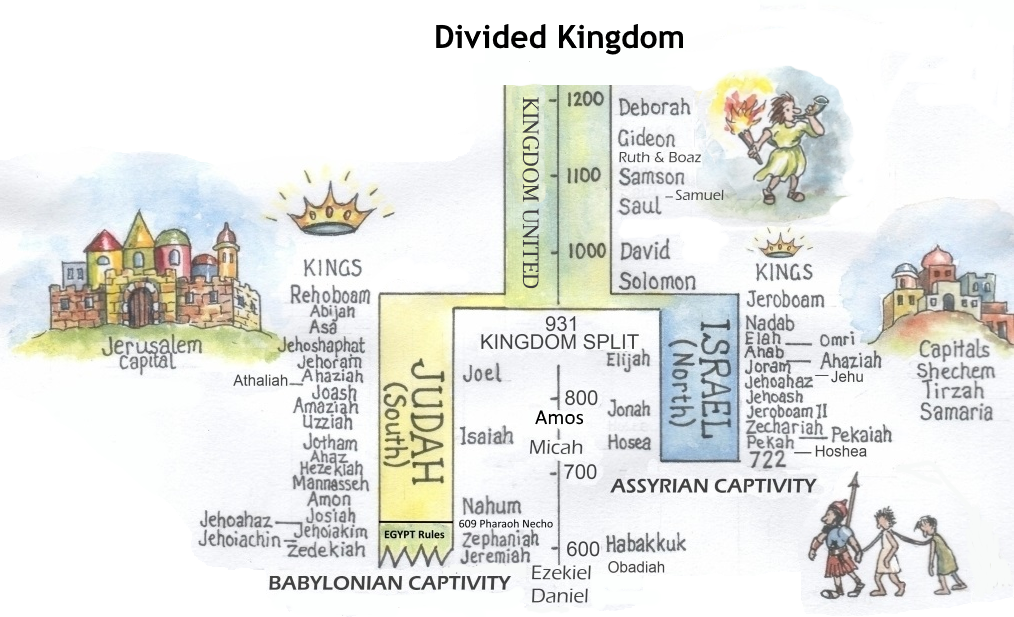
After Solomon died, his son Rehoboam reigned. He was a foolish king who taxed the people excessively. Finally, ten tribes of Israel rebelled and set up their own Kingdom just as God had promised Solomon. Only the tribes of Judah and Benjamin stayed loyal to Rehoboam. The Northern kingdom retained the name ‘Kingdom of Israel’, while the Southern Kingdom was called Judah (after the biggest tribe). The King of Israel, Jeroboam, set up idol worship throughout Israel, while the people of Judah still worshipped God in the Temple at Jerusalem. This period is covered in the Bible books of 1and 2 Samuel, 1 and 2 Kings and 1 and 2 Chronicles.

TIMELINE SPLIT

The Prophets

For about the next 400 years, God sent many prophets (Elijah, Elisha, Isaiah, Joel, Amos etc.) to plead with the people of Israel and Judah to stay loyal to Him. They didn’t. Finally, God allowed the Assyrian Kings to conquer Israel and take them all away into captivity (into modern day Iraq).

Then God sent more prophets to Judah begging them to learn from Israel’s mistakes. They didn’t. The prophet Jeremiah was still preaching when the Kingdom of Babylon came and took Judah captive.captivity iron chains 300 The prophets Ezekiel and Daniel were among the captives of Judah taken to Babylon. The Bible books of Ezekiel and Daniel give wonderful prophecies of Israel coming back to their ‘Promised Land’, as well as future world history.

The Kingdom of Persia overtook the Babylonian Kingdom, and so the Persians became the rulers of the people of Judah. The Word Judah was shortened to ‘Jew’. The Persian King Cyrus decreed that the Jews could return to their native homeland. Zerubbabel led the first return and the temple was re-built, but the offer of foreign help was rejected.

The Bible book of Esther tells of a courageous Jewish woman who married a Persian King and saved the Jews from destruction at the hands of the Persians during this period.

Some 50- 60 years after the first return, Ezra and Nehemiah led more Jews back and the city of Jerusalem was rebuilt. The offer of foreign help was again rejected.

The Greeks then fell to the Romans who set up ‘puppet Kings’ like Herod and governors like Pontius Pilate. This was the world into which Jesus the Christ was born and died, but rose to life. After seeing Christ back from the dead, His followers (disciples) took the message of the Gospel – the ‘Good News’ of God’s salvation, beyond the borders of Israel into all the world.

The Romans continued to rule the land of Israel. In 70 AD they destroyed the temple and the city of Jerusalem. Hadrian re-built Jerusalem and named it Aelia Capitolina. In 135 AD he crushed the final Jewish rebellion and banished Jews. He re-named Judea ‘Syria Palaestina’. The Jews were scattered from their homeland.

The Bible:

Consists of two sections:

The Old Testament made up of 39 books. The Law of God for Israel, The Histories, The Poetry, and the Prophets.

The New Testament is made up of 4 Gospels, The History of the early Christian Church, The letters of Apostles to the believers and Prophecy.

PART 2 – How to become a Christian

Love

In the Gospel of Matthew, Jesus was asked:

“Teacher, which is the greatest commandment in the Law?” Jesus replied: “‘Love the Lord your God with all your heart and with all your soul and with all your mind.’ This is the first and greatest commandment. And the second is like it: ‘Love your neighbour as yourself.’  All the Law and the Prophets hang on these two commandments.” [Matthew 22:36-40]

The greatest of all Christian principles is to love both God and people.

Jesus also said in the Gospel of John  

“A new command I give you: Love one another. As I have loved you, so you must love one another. By this everyone will know that you are my disciples, if you love one another.” [John 13:34-35]

And although a Christian life is also built on faith and hope as well as love, Paul tells us that the greatest of these is love:

 “And now these three remain: faith, hope and love. But the greatest of these is love.” [1 Corinthians 13:13]

Faith

Hebrews 11 is a wonderful chapter about faith in the lives of believers. In part it states:

“And without faith it is impossible to please God, because anyone who comes to Him must believe that He exists and that He rewards those who earnestly seek Him.” [Hebrews 11:6]

The Bible Book of Hebrews also tells us in chapter 11

“Now faith is the substance of things hoped for, the evidence of things not seen”.  [Hebrews 11:1]

We are not asked to follow a blind faith – but a faith based on solid evidence. Paul tells us in his letter to the Romans  

Since what may be known about God is plain to them, because God has made it plain to them. For since the creation of the world God’s invisible qualities—his eternal power and divine nature—have been clearly seen, being understood from what has been made, so that people are without excuse.” [Romans 1:19-20].

The Old Testament book of Psalms chapter 19 says

“The heavens declare the glory of God; the skies proclaim the work of his hands. Day after day they pour forth speech; night after night they reveal knowledge. They have no speech, they use no words; no sound is heard from them. Yet their voice goes out into all the earth, their words to the ends of the world.” [Psalms 19:1-4].

So our faith is built on the evidence God has provided.

How do we get this faith?

The apostle Paul writes in the book of Romans

So then faith comes by hearing, and hearing by the word of God.” [Romans 10:17].

The word of God is our Bible. It is here that we learn of God and develop our faith. God has given us the Bible which contains His message to all his prophets and faithful women and men of all ages.

Paul writes to his friend Timothy saying,

“All Scripture, given by inspiration of God, is profitable for doctrine, for reproof, for correction, for instruction in righteousness, that the man/woman of God may be complete, thoroughly equipped for every good work.”      [2 Timothy 3:16-17].

Although God spoke through many servants – He has finally spoken to us through Jesus. In the book of Hebrews we read

“In the past God spoke to our ancestors through the prophets at many times and in various ways, but in these last days he has spoken to us by his Son, whom he appointed heir of all things, and through whom also he made the universe.” [Hebrews 1:1-2].

Grace

Jesus gave us the perfect pattern of living. Perfect faith, perfect love. We are asked to follow in the path which Jesus laid out. The first letter of Peter says  

To this you were called, because Christ suffered for you, leaving you an example, that you should follow in his steps.” [1 Peter 2:21].

Jesus himself said this:

Then Jesus told his disciples, “If anyone would come after me, let him deny himself and take up his cross and follow me.  For whoever would save his life will lose it, but whoever loses his life for my sake will find it.” [Matthew 16:24-25].

But we all fail. We all make mistakes and fail to properly live a Godly life. But – all is not lost. We are told;

“But if anyone does sin, we have an advocate with the Father, Jesus Christ the righteous.  He supplies forgiveness for our sins, and not for ours only but also for the sins of the whole world.” [1 John 2:1-2]

Forgiveness which we don’t deserve, but is freely given to us is called grace. We can never save ourselves by trying to be good all the time – but rather our salvation comes from God’s grace.

Paul tells the Ephesians,  

For it is by grace you have been saved, through faith – and this is not from yourselves, it is the gift of God – not by works, so that no one can boast.” [Ephesians 2:8-9].

We have all sinned – we all depend on God’s grace.

 For all have sinned and fall short of the glory of God” [Romans 3:23].

Faith in Action

We need to put the faith and love in our lives into action. James [very probably Jesus’ brother] wrote:

14 What does it profit, my brothers, if a man says he has faith but has not works? Can his faith save him?…. 17 So faith by itself, if it has no works, is dead. 18 But someone will say, “You have faith and I have works.” Show me your faith apart from your works, and I, by my works, will show you my faith. [James 2].

To love is to help the poor, the needy and the downtrodden.

“Religion that is pure and undefiled before God and the Father is this: to visit orphans and widows in their affliction, and to keep oneself unstained from the world.” [James 1:27]

35 “For I was hungry, and you gave me food, I was thirsty and you gave me drink, I was a stranger and you welcomed me, 36 I was naked and you clothed me, I was sick and you visited me, I was in prison and you came to me.’… 40 And the King will answer them, ‘Truly, I say to you, as you did it to one of the least of these my brothers, you did it to me.” [Matt. 25]

We are not saved by our works (it is by Grace we are saved), but we demonstrate and proclaim our faith by following the example of Jesus and serving others, not ourselves.

Why Do We Sin?

We only have ourselves to blame if we sin:

 Let no one say when he is tempted, “I am tempted by God”; for God cannot be tempted with evil and he himself tempts no one; but each person is tempted when he is lured and enticed by his own desire.” [James 1: 13].

But we can come to Jesus to seek forgiveness when we sin:

If we claim to be without sin, we deceive ourselves and the truth is not in us.  If we confess our sins, he is faithful and just and will forgive us our sins and purify us from all unrighteousness. If we claim we have not sinned, we make him out to be a liar and his word is not in us.”        [1 John 1:8-10].

We are not saved by our own goodness, but by grace freely given.

Then what does the Bible say of the Devil?

Many churches have now realise that there is no supernatural devil.

The Church of England voted to change its baptism service which will no longer includes a promise by parents and godparents to “reject the devil and his rebellion against God”. Instead, they will be asked to “turn away from sin and stand bravely against evil.”

This is a true representation of what the Bible says. Many Christians are now coming to realise that the concept of a supernatural devil in not in the Bible.

The Old Testament of the Bible was written in the language of the Jews – Hebrew. The Hebrew word for devil is sa`iyr, which simply means a goat. Here is an example:

And he ordained him priests for the high places, and for the devils (goats), and for the calves which he had made.” [2 Chronicles 11: 15].

So – there is no supernatural devil in the Old Testament.

The New Testament of the Bible was written in the common language of the time – Greek. There are two Greek words used for devil in the Bible. The first is daimonizomai which represents the mental illnesses some people suffer. Some Bibles use the word devil and others demon for this Greek word. As people in the ancient world had no idea what caused mental illness – they assumed an evil demon had invaded a person’s body. Here are some examples:

            “… and they brought unto him all sick people that were taken with diverse diseases and torments, and those which were possessed with devils, and those which were lunatic (mentally ill), and those that had the palsy; and he healed them.”[Matthew 4:24].

 “Lord, have mercy on my son: for he is lunatic (some Bible versions say epileptic here) … And Jesus rebuked the devil; and he departed out of him: and the child was cured from that very hour.”   [Matthew 17:15,18].

So, clearly, a devil is simply a mental disease or epilepsy.

The other Greek word for devil is diabolos which simply means a slanderer or a liar. As an example, the first letter of Peter says

Be alert and of sober mind. Your enemy the devil (the liar, slanderer) prowls around like a roaring lion looking for someone to devour.” [1 Peter 5:8].

The devil here was the Roman Empire falsely accusing Christians and throwing them to lions.

In the Gospel of John we read:

“Then Jesus replied, “Have I not chosen you, the Twelve? Yet one of you is a devil!” [John 6:70].

Clearly Judas Iscariot, the one who betrayed Jesus, was the liar.

Sometimes the word devil just represents the rebellion and sin which is in us all. The snake in the garden of Eden was a liar, and was the first ‘devil’. Jesus said:

“ You belong to your father, the devil, and you want to carry out your father’s desires. He was a murderer from the beginning, not holding to the truth, for there is no truth in him. When he lies, he speaks his native language, for he is a liar and the father of lies” [John 8:44].

Here Jesus accused the church leader of following the lying snake in Eden. The devil (liar) represents all falsehood against Jesus and God.

What about Satan?

It used to be thought that Satan was another name for the devil, but many churches have come to realise that just as there is no supernatural devil – so there is no Satan.

The Old Testament (Hebrew) for Satan is Satan. Wow – what a coincidence – the English and Hebrew words are the same. No – it’s not a coincidence! The translators decided NOT to translate the word – even though it has a perfectly good English meaning. They wanted us to believe Satan was something mysterious – a supernatural person. The Hebrew word Satan simply means an adversary or enemy.

 “And God’s anger was kindled because he went: and the angel of the Lord stood in the way for a Satan (adversary) against him.” [Numbers 22:22].

Here the Bible calls an angel of the Lord Satan, because he opposed Balaam. In another place it says:

 “And David said, What have I to do with you, you sons of Zeruiah, that you should this day be Satans (adversaries) unto me? shall there any man be put to death this day in Israel?” [2 Samuel 19:22]

Here, King David called men ‘Satans’

1 Chronicles 21:1And Satan stood up against Israel, and provoked David to number Israel. 2 Samuel 24:1  Again the anger of the Lord burned against Israel. He moved David against them, saying, “Go, number Israel and Judah.”

These two passages describe the same event. One says God caused David to act, the other passage says Satan did. Is God Satan? Yes – because God was an adversary to Israel.

The New Testament (Greek) word for Satan is Satanas, simply the Greek form of the Hebrew word Satan. Again, it just means adversary or enemy.

In the Gospel of Matthew Jesus says:  

Then Jesus turned to Peter and said, “Get behind Me, Satan! You are standing in My way. You are not thinking how God thinks.” [Matthew 16:23].

Jesus called Peter Satan because he was being an enemy to God’s plan.

Sometimes Satan can be used to represent the power of sin, as sin is always the enemy of God.  We read:

Then Satan entered Judas, called Iscariot, one of the Twelve.” [Luke 22:3].

 This simply means that the thoughts of sin took over Judas’ mind, and Judas became an enemy of God. Satan becomes a personification of sin: that is it takes on a personal identity representing sin.

In many places the word Satan just means sin which is the enemy of God. We read:

 “Then Peter said, “Ananias, how is it that Satan (the enemy) has so filled your heart that you have lied to the Holy Spirit…” [Acts 5:3].

Greed and the love of money had filled Ananias’ heart – they are God’s enemies.

DEATH00What happens to people when they die?

The Bible states clearly that we all die, lie in the grave until the return of Jesus and the judgement of God. Many churches now realise that the concept of ‘Hell’ as a place of eternal torment is not in the Bible – and has been misunderstood.

A Church of England report says

“In the past the imagery of hell-fire and eternal torment and punishment … has been used to frighten men and women,” says the report. “Christians have professed appalling theologies which made God into a sadistic monster. … Hell is not eternal torment, but is the final and irrevocable choosing of that which is opposed to God so completely … that the only end is total non-being.”

An Observer (Anglican on-line post) editorial noted that the state church is saying that if

Heaven is where life with God continues forever, hell is now personal annihilation. Game over, just as atheists always believed.”

The Bible is really clear on what happens to us after death. In the book of Daniel we read:

“Multitudes who sleep in the dust of the earth will awake: some to everlasting life, others to shame and everlasting contempt. Those who are wise will shine like the brightness of the heavens, and those who lead many to righteousness, like the stars for ever and ever.” [Daniel 12:2-3].

Clearly those who have chosen Jesus will be rewarded with eternal life – and those who have rejected Jesus will be rejected back to death (God’s contempt).

­­“For since death came through a man, the resurrection of the dead comes also through a man. For as in Adam all die, so in Christ all will be made alive. But each in turn: Christ, the firstfruits; then, when he comes, those who belong to him……For he must reign until he has put all his enemies under his feet. The last enemy to be destroyed is death. [1 Corinthians 15:21-26].

This is so clear – we will be raised and given eternal life.

Even the people of Jesus day expected to die and wait in the grave for ‘the resurrection’.

Jesus said to her, “Your brother will rise again.” Martha answered, “I know he will rise again in the resurrection at the last day.” Jesus said to her, “I am the resurrection and the life. The one who believes in me will live.” [John 11:23-25].

So, clearly, when we die, we stay in the grave until Jesus comes and we are resurrected to judgement. We do not go to heaven or hell and we have no immortal soul.

But, what of hell in the Bible?

In the Old Testament, hell is the Hebrew word “she’owl” simply meaning the grave. In the book of Samuel in the old King James Version, we read:

The sorrows of hell compassed me about; the snares of death prevented me;” [2 Samuel 22:6].

But the more modern New International Version says

“The cords of the grave coiled around me; the snares of death confronted me.”

They recognise that hell is just the grave.

Everywhere in the Old Testament the word for hell is just the grave.

In the New Testament, is seems more difficult. There are two New Testament words for hell. The most common is hades, a word the Greeks used for the underworld, the place of the dead. But Jesus did not speak Greek – he spoke Hebrew or Aramaic. So – what did Jesus say? We can find out by matching the Greek version of the Old Testament with the Hebrew version. Everywhere hades is used in the Greek Old Testament, the Hebrew word is she’owl. So, we now know that when our Greek Bible says hades, Jesus actually said she’owl – the grave.

Jesus says:

 And I say also unto you, That you are Peter, and upon this rock I will build my church; and the gates of hell (hades, she’owl, the grave) shall not prevail against it.” [Matthew 16:18].

All new Bible versions replace hell with hades, the grave or death.

Another word often used in the New Testament is Gehenna. This was a literal rubbish dump outside of Jerusalem where rubbish was burned, and the bodies of uncollected criminal were thrown. The fire was never extinguished – so it was thought to be everlasting. The bodies of criminals and animals were thrown here and infested with maggots. It represented utter destruction.

Jesus says:  

If your right eye causes you to stumble, gouge it out and throw it away. It is better for you to lose one part of your body than for your whole body to be thrown into hell (Gehenna).  [Matthew 5:29].

Jesus didn’t intend this to be taken literally or for anyone to lose an eye. It was a figure of speech. Jesus was saying it is better to lose something that distracts you in this life than to face eternal destruction (death) in the next.

Further, Jesus says

And if your eye causes you to sin, pluck it out; it is better for you to enter the kingdom of God with one eye than with two eyes to be thrown into hell (gehenna), where their worm does not die, and the fire is not quenched.” [Mark 9:47-48].

This is a direct reference to the rubbish dump which was always burning and the bodies were full of worms perpetually.

The Promise of Jesus

Jesus did not just arrive in the New Testament from nowhere. He was predicted many times in the Old Testament, where God made wonderful promises about our salvation through Him.

God has made great and wonderful promises to us all. Right after the first sin by Adam and Eve, God gave this promise.

“To the serpent He said: I will put enmity between you and the woman, and between your offspring and her offspring; he shall bruise your head, and you shall bruise his heel.” [Genesis 3:15].

This was the first promise of Jesus.

The snake represented sin (human rebellion against God). The offspring of the woman was Jesus.

“I will put enmity (make you enemies) between you and the woman, and between your offspring and her offspring; he (Jesus) shall bruise your head (a mortal wound – Jesus killed sin and death by his sacrifice), and you (the serpent – the power of sin) shall bruise his heel (a non-mortal wound – Jesus died but rose again to life eternal).”

Another promise of Jesus.

God found a faithful couple in Abraham and Sarah. Then, because of Abraham’s faith, God gave another promise of Jesus. God said to Abraham: abe border

I will indeed bless you, and I will multiply your seed (people of faith) as the stars of heaven and as the sand which is on the seashore. And your seed shall possess the gate of His enemies (Jesus conquered death and will rule the world), and by your seed (Jesus) shall all the nations of the earth be blessed.” [Genesis 22:17-18].

We, who are not literal descendants of Abraham are ‘adopted in’ by faith in Jesus Christ. The apostle Paul tells us:

There is neither Jew nor Gentile, neither slave nor free, nor is there male and female, for you are all one in Christ Jesus. If you belong to Christ, then you are Abraham’s seed, and heirs according to the promise”. [Galatians 3:28-29].

Still another promise of Jesus.

David was a great King of Israel and was faithful to God (although he made many mistakes) and so God extended His promises to him.

When your days are fulfilled and you lie down (in death) with your fathers, I will raise up your offspring after you (a descendant of David – Jesus), who shall come forth from your body, and I will establish his kingdom.  He shall build a house for my name, and I will establish the throne of his kingdom for ever (Jesus will reign forever). [2 Samuel 7: 12-13].

The temple which Jesus was to build is a spiritual Temple – the letter of Peter says Christians make up that temple

You also, like living stones, are being built into a spiritual house”.[ 1 Peter 2:5]

Yet another promise of Jesus.

The promise of salvation in Jesus was added to by the prophets:

baby Jesus For to us a child is born, to us a son is given; and the government will be upon his shoulder, and his name will be called “Wonderful Counsellor, Mighty God, Everlasting Father, Prince of Peace.” Of the increase of his government and of peace there will be no end, upon the throne of David (he will be Jewish – from David’s lineage), and over his kingdom, to establish it, and to uphold it
with justice and with righteousness from this time forth and for evermore.”
[Isaiah 9:6-7].

And so, Jesus was born as the fulfilment of all these promises – to save man from a destiny of sin and death. Jesus was the son of God (Jesus had no earthly father) and the son of David (through Mary).

“For God so loved the world that he gave his one and only Son, that whoever believes in him shall not perish but have eternal life.”[John 3:16].

When Jesus died on the cross – it seems that all these promises failed. But his resurrection brought them all to life again.

Passover Symbol of Jesus

The Jewish people were slaves in Egypt (Book of Exodus). Pharaoh felt threatened by them and commanded all male Jewish babies to be killed. To release them, God proposed to destroy the firstborn of every family in Egypt. The only way to be saved from this fate was to take the blood of a perfect lamb and spread it over your door posts.  God instructed

 “…On the tenth day of this month each man is to take a lamb for his family, one for each household…  The animals you choose must be year-old males without defect… Take care of them until the fourteenth day of the month, when all … of Israel must slaughter them at twilight. Then they are to take some of the blood and put it on the sides and tops of the doorframes of the houses…” [Exodus 12:1-9].CROSS lamb

We are destined to death. Our only hope of salvation is through the ‘Lamb of God’. The Passover lamb became a household pet for 3 ½ days – Jesus was God’s ‘loved one’ for 3 ½ years. The lamb was without defect – as Jesus was sinless. The people took shelter under the blood of the lamb on their door frames, just as we take shelter under the blood of the cross to save us from death.

“The Law (of Moses) was only a shadow of good things to come and could never with the same sacrifices…make perfect those drawing near.” [Hebrews. 10:1]

The Nature of Jesus

We read in Isaiah  

Therefore the Lord himself will give you a sign: The virgin will conceive and give birth to a son, and will call him Immanuel.” [Isaiah 7:14].

Immanuel means ‘God with us’. This promise was fulfilled in the birth of Jesus:

“Behold, a virgin shall conceive and bear a son, and his name shall be called Emman′u-el” [Matthew 1:23].

This sounds like Jesus was God – but this cannot be so. The name Immanuel has also been given to Israel in the very next chapter of Isaiah

“Its (Assyria’s) outspread wings will cover the breadth of your land, Immanuel!” [Isaiah 8:8].

Here, God is calling the nation of Israel Emmanuel. Israel were God’s chosen people, and should have represented God to the whole earth – but they failed.

Anyone who represents God is permitted to bear His name.

Often the name of the Lord is used for angels (who are not God):

“The angel of the Lord came and sat down under the oak… When the angel of the Lord appeared to Gideon, he said, “The Lord is with you, mighty warrior…  The Lord turned to him and said…” The Lord answered, “I will be with you…And the Lord said, “I will wait until you return.” … The angel of God said to him…” [Judges 5:11-20].

It is very acceptable to carry the name of God when someone is in His service.

Jesus never claimed to be God. But He did claim to be God’s Son and carry God’s name

“We are not stoning you for any good work,” they replied, “but for blasphemy, because you, a mere man, claim to be God.” Jesus answered them, “Is it not written in your Law, ‘I have said you are “gods”’ (Psalm 82:6) ? 35 If he called them ‘gods,’ to whom the word of God came …what about the one whom the Father set apart as his very own and sent into the world? Why then do you accuse me of blasphemy because I said, ‘I am God’s Son’?” [John10:33-36].

Jesus claimed to be God’s Son … not God.

When Jesus was taken into heaven – He promised to return.

In the book of Acts it says

“So when they had come together, they asked him, “Lord, will you at this time restore the kingdom to Israel?” (the disciples expected him to set up David’s throne again) He said to them, “It is not for you to know times or seasons which the Father has fixed by his own authority. (Jesus is saying that David’s Kingdom will be set up again – but in God’s good time)…  And when he had said this, as they were looking on, he was lifted up, and a cloud took him out of their sight.  And while they were gazing into heaven as he went, behold, two men stood by them in white robes, and said, “Men of Galilee, why do you stand looking into heaven? This Jesus, who was taken up from you into heaven, will come in the same way as you saw him go into heaven.” [Acts 1:6-11].

Jesus’ disciples expected His return to set up God’s Kingdom on earth.

Those who have died will be raised from the dead to be given everlasting life.

The prophet Daniel says

“And many of those who sleep in the dust of the earth shall awake, some to everlasting life, and some to shame and everlasting contempt. And those who are wise shall shine like the brightness of the firmament; and those who turn many to righteousness, like the stars for ever and ever.” [Daniel 12:2-3].

The apostle Paul writes

For the Lord himself will descend from heaven with a cry of command, with the archangel’s call, and with the sound of the trumpet of God. And the dead in Christ will rise first; then we who are alive, who are left, shall be caught up together with them in the clouds to meet the Lord in the air; and so we shall always be with the Lord.” [1 Thessalonians 4:16-17].

So – we who wait for His return, depend on His grace for the forgiveness of our sins.

REASONS TO BELIEVE

God has given us solid reasons to believe. An evidence-based faith.

Logic

Isaac Newton – One of the most influential scientists of all time, said –

“This most beautiful system of the sun, planets, and comets, could only proceed from the counsel and dominion of an intelligent Being.”

Arthur L. Schawlow (Professor of Physics at Stanford University, 1981 Nobel Prize in physics): “It seems to me that when confronted with the marvels of life and the universe, one must ask why and not just how. The only possible answers are religious”

Look around -The World itself testifies to a Creator – As the apostle Paul said

“By taking a long and thoughtful look at what God has created, people have always been able to see what their eyes as such can’t see.” Romans 1:29 MSG Bible

Almost 1,000 years earlier, King David said much the same thing – “The heavens declare the glory of God. The skies proclaim the work of his hands.” Psalm 19:1

Bruce Barton put it this way –

“When you can dump a load of bricks on a corner lot, and let me watch them arrange themselves into a house – when you can empty a handful of springs and wheels and screws on my desk, and let me see them gather themselves together into a watch – it will be easier for me to believe that all these thousands of worlds could have been created, balanced, and set to moving in their separate orbits, all without any directing intelligence at all.”

Testimony of Eyewitnesses

First Century eyewitnesses and those who followed in their steps, were willing to suffer and die for their testimonies – some were thrown to the lions for being Christians – such was their conviction after seeing Jesus back from the dead and faith in something better to come.

Accurate, Fulfilled Prophecy

During Old Testament times, two great powers competed for control – Babylon and Egypt. God knew their future – and told their fate before it happened.

He said the city of Babylon would become an uninhabited ruin

“Babylon, the jewel of kingdoms, the glory of the Babylonians’ pride, will be overthrown…She will never be inhabited or lived in through all generations.” Isaiah 13:19-20

This happened – Just about all other ancient capitals are still lived in, to this day – but not Babylon!

The promise to Egypt was different: It would remain inhabited, but be the lowest of nations – “It will be the lowliest of kingdoms and will never again exalt itself above the other nations.” Ezek. 29:15 – Never to rule the world again.

The prophecies of Babylon and Egypt are both amazingly accurate.

ISRAEL:  God said he would scatter the Jews from one end of the earth to the other because they broke their covenant with Him. He said they would

“Become a thing of horror, a byword and an object of ridicule among all the peoples where the LORD would drive them.”   (Deuteronomy 28:37)

This prophecy was also fulfilled and for almost 2,000 years the Jews were a witness to its accuracy, in their dispersion.

But the prophecies continue. In the end times God would bring the Jews back to the Promised Land – “I will bring you back to the land of Israel.”  Ezekiel 37:11

This happened after the 2nd World War. No other nation has been scattered as prophesied and then brought back as foretold in advance. Once the Jews returned, Jerusalem was prophesied to be a source on contention –

“I will make Jerusalem a cup of drunkenness to all the surrounding peoples. Zech. 12:2

This is an astounding prophecy. Jerusalem is the most contested piece of real estate on the planet.

FUTURE PROPHECIES

God has said there will be a Holy war over Jerusalem. Who would have thought such a prophecy would come true, yet the signs are there for a future war in the name of religion.

Holy War – Joel 3:9 “Proclaim this among the nations (around Israel): Prepare for holy war!” (sanctify a war)

Jesus comes in the midst of this war to save Israel and make those in Israel who accept Him dwell securely.  (Isaiah 59:20, Zechariah 12)

After the holy war, others come to ‘take a spoil’ – not realising that Jesus has returned. What ‘spoil’ could Israel have that would draw in other countries – surely the huge reserves of newly discovered gas and their technology –

“You will say, “I will go up against a land of unwalled villages; I will come against a tranquil people who dwell securely, all of them living without walls or bars or gates – in order to seize the spoil and carry off the plunder.” Ezekiel 38:11

Armies of the world swept away – Another prophecy speaks of the futile attempt of any army to come against Jesus

The kings of the earth take their stand and the rulers gather together, against the LORD and against His Anointed The One enthroned in the heavens laughs;…He rebukes them in His anger, and terrifies them in His fury:“I have installed My King on Zion, My holy hill.”  Psalm 2:4-6

What Must We do to be Saved?

Paul tells the Ephesians

“For by grace you have been saved through faith; and this is not your own doing, it is the gift of God, not because of works, lest any man should boast.” [Ephesians 2:8]

How do we come to this grace?

In Acts 2, the apostle Peter preached Jesus to the very crowds who had killed Him. They were convicted of their sin:

Now when they heard this they were cut to the heart, and said to Peter and the rest of the apostles, “Brethren, what shall we do?”  And Peter said to them, “Repent, and be baptized every one of you in the name of Jesus Christ for the forgiveness of your sins…” [Acts 2:37].

We, likewise, need to repent and to be baptised, as an adult with full emersion

“Do you not know that all of us who have been baptized into Christ Jesus were baptized into his death? 4 We were buried therefore with him by baptism into death, so that as Christ was raised from the dead by the glory of the Father, we too might walk in newness of life. 5 For if we have been united with him in a death like his, we shall certainly be united with him in a resurrection like his.” [Romans 6:3].

Jesus last words were:  

“Go into all the world and preach the gospel to all creation. Whoever believes and is baptized will be saved, but whoever does not believe will be condemned.” [Mark 16:15-16].

Choose Eternal Life

In these uncertain times, it’s reassuring to know that God has a wonderful plan for the earth that we can be part of. God has given us the ultimate choice, life or death.

Choose life – Eternal life. Follow Jesus.

This article will soon be available as a printed booklet –

CONTACT

If you have any questions or things you’d like to discuss –

Please Contact 

John Thatcher: Email: john.thatcher555@gmail.com

Website: https://reneweddayafterday.home.blog/