This 5 minute podcast condenses hours of Bible teaching (from reneweddayafterdayhome.wordpress.com) and asks: What if the text itself tells a different story than the one we inherited?
It argues that something shifts with Elijah — a seismic turn where Gentiles like the widow of Zarephath and Naaman belong to God without keeping the Law, echoing Noah’s “righteousness by faith.”
At every Passover a seat waits for Elijah the TISHBITE — what if he’s not the figure we expected?
This video explores the ages of Law and Faith, re‑examining Elijah, Noah, Jonah, the “wicked women,” even the nature of God. It follows the language of Scripture wherever it leads, then turns to physics to explore what it means that “God is light.”
If you’re ready for a study that sees the text through fresh eyes — this is for you.
In the most unusual places throughout the Bible, Elijah comes up. And you sort of think, why?
I mean, yes, there was the Mount Carmel incident, but why was it that he keeps coming up? And why was he taken to heaven? No other prophets were taken to heaven. Why did Malachi say that Elijah would come before the day of the Lord? He was only the second person ever after Moses to go up into Mount Horeb.
And if God said of Moses –
“I have spoken to my other prophets in dreams and in visions”,
then I’m sure he’d also say, “But to Elijah I spoke face to face.”
And he’s been linked to Moses forever. He’s only the second after Moses to go up on that mountain. He appeared with Moses at the Mount of Transfiguration. No other prophets.
He also turns up in the book of Revelation. No other prophet turns up in the book of Revelation.
Many others have their visions quoted. For instance, Revelation will give visions of the throne room of God, very similar to Isaiah 6 and Ezekiel 1, but none of the prophets turn up, except Elijah.
Why?
When the people of Israel left Egypt, it says in Exodus 12 that a mixed multitude went out with them.
Mixed Multitude
And I want to just stop there for a minute and think about who that mixed multitude was.
Don’t worry, we’ll get back to Elijah.
Who was that mixed multitude that went out?
And we’d imagine there would have been some Egyptians who would have thought, “Well, this is the true God, even though we’re Egyptians, there certainly is a real God who has inflicted these terrible plagues on us.”
But there’s more than that.
There were also a lot of Canaanites in Egypt which were not Hebrews.
Hyksos
They were called the Hyksos and had been nicknamed the Shepherd Kings.
And these were people who had come down before Joseph, and they had moved into the land of Goshen, which is in the Nile Delta. So, all of these people had come down, many of them. In fact, they became so numerous that they actually took over the kingship of Egypt.
So, when Joseph came down, the king of Egypt was not an Egyptian. He was one of the Hyksos, one of the ones that had been nicknamed the shepherd kings.
And the Egyptians didn’t know the difference between the Hyksos and the Hebrews, to them they were all Canaanites, didn’t make much difference.
And you sort of stop and you think to yourself, well that explains a lot of the verses in Genesis that I don’t understand. Because Joseph said to his family, when you present yourself to Pharaoh, make sure you make him understand you are shepherds.
Why?
Because Egyptians hate shepherds. Why on earth would you tell the king that you were shepherds knowing he hated them?
Because he wasn’t an Egyptian, he was one of the Hyksos kings – the shepherd kings.
Do you remember when Joseph shared a meal with his brothers and it said, “The Egyptians will not eat with the Hebrews”? They wouldn’t eat with the Canaanites, they would not eat with the Hyksos, they hated them. Absolutely hated them.
And as Joseph works through his plan, he eventually virtually enslaves the Egyptians. The Egyptians had to sell their land to get food after the time of famine.
Hyksos Left
So, these are the people who joined themselves with the Hebrews and left.
Of course, once an Egyptian pharaoh took over, then he punished both the Hyksos and the Hebrews identically, and so they all went out together.
What did God say about these people who were not Israelites?
We read it in Exodus 12:48 –
And when a stranger dwells with you to keep the Passover to the Lord, all his males must be circumcised, and let him come near and keep it, and he shall be as a native of the land, for no uncircumcised person shall eat it. One law will be for the native born and for the stranger who is amongst you.
Every native of another place and all native of Hebrews, would join together.
They would become one people.
So, there were many people who joined in with the Hebrews who were not of Abraham’s line.
So, these people, mixed people, mixed motherhood, probably some Egyptians, lots of the Hyksos, they moved in and they all became Israelites.
Under this condition they must obey the law.
It says there shall be one Law for the native Hebrews and for the people in amongst them.
ONE LAW
Now that’s important.
From this point onwards you’ll find everybody who comes into the land of Israel, who belongs and joins themselves to the Israelites, they all fall in with the law of Moses and obey the law of Moses until Elijah.
Rahab
Rahab the harlot married Salmon.
I feel a bit sorry for her with that epithet, ‘Rahab the harlot’. She obviously had stalks of flax on her roof, but no one calls her Rahab the flax dryer, but she gets what she gets. Some people have said she was actually an innkeeper. That’s possible. I think that it might be a bit of a Me-Too movement thing, but maybe not.
Whichever, it doesn’t matter. She married Salmon and she became a part of the line of David and Jesus Christ.
And she was a Canaanite. And in fact, they disobeyed Deuteronomy 7. The very thing that Deuteronomy said is, “Do not make a covenant with these people – kill them all.”
But do not join with them and whatever you do, don’t marry them. That was absolutely strict.
First thing they did, made a covenant with the people and married Rahab.
Because grace overcomes law.
Because the grace of God is supreme over law.
Ruth
Ruth, she was a Moabitess. It was said,
“No Moabite shall come into the family of the Lord, or to the people of the Lord, unto 10 generations.”
But she came in and married Boaz and also became a pro-genitor of David and of Jesus. And it was fairly obvious when she came in that she was no longer a Moabite.
She became an Israelite. She said, “Your God shall be my God.” And she would have obeyed all of the rules of the law of Moses, everything.
Uriah
Uriah the Hittite, well, I don’t know, but I’m sure he was circumcised, he kept the law, he married into royalty. He married Ahithophel’s granddaughter. He could not get any higher than that in the Hebrew society.
All the Gittites that served David, I’m sure, all kept the law, absolutely.
And so, all of them found salvation by coming into Israel and obeying the law.
What Changed with Elijah?
What changed with Elijah?
Everything!
The first Gentile we see Elijah, convert, if you like, was the widow of Zarephath. She said, “Truly I know this is a man of God – because of the miracles he has performed.”
Did she come into Israel?
No.
Did she keep the law? Not that I know. The Sabbath?
No.
Did she keep the laws of purification for a woman? No.
All of those rules to keep The Law, changed.
Naaman
How about Naaman? Naaman was baptized and completely lost that curse of leprosy.
What did he do then? Did Elisha circumcise him?
No.
Did Elisha tell him to come into Israel to become a part of the family of God?
No.
In fact, he even went back to go into the temple of his own God so the king could lean on his arm and Elisha said, You’re okay, mate.
It all changed with Elisha.
Jonah’s Assyrians
Jonah got sent to the Assyrians to convert them, to tell them of their wicked ways.
And they all, 120,000 people, gave in and they said, “We will worship Yahweh and repent of our ways.”
Do you think Jonah circumcised 120,000 people?
It would take him a long time.
No.
Did they keep the Sabbath? No.
Did they keep the law?
No.
It all changed with Elijah from that point onwards.
Nebuchadnezzar
How about Nebuchadnezzar? God sought Nebuchadnezzar. God chased him.
God must have loved that man because he chased him and even drove him out to live seven years eating grass like a donkey.
God did everything to win him over. Do you think he joined Israel? Do you think he started keeping the law?
No.
Okay, keep going. Darius, Cyrus, all of these people came to know God, but none of them had to fulfill those laws of Exodus 12, where they had to come in and become Israelites.
JESUS
This brings us to one of the words of Jesus.
In the very first part of Jesus’ ministry, the very first act of Jesus’ ministry, he went to Nazareth, where of course he was not accepted because a prophet is not without honour except in his own country.
And this is what Jesus said, and this is what got them really annoyed.
In Luke chapter 4 –
“I assure you that there were many widows in Israel in Elijah’s time, yet Elijah was not sent to any of them, but a widow in Zarephath in the region of Sidon. (Today we would say Lebanese)
And there were many in Israel with leprosy in the time of Elisha the prophet, yet none of them were cleansed, only Naaman the Syrian.”
The crowd were furious, and they took him out to a hill to throw him over to his death, but God saved him. Why did they get so furious? Why were they angry about those two examples?
It wasn’t that they didn’t know Gentiles could be accepted. They knew about Rahab. They knew about Ruth. They knew about the mixed multitude who were not Jewish, but all got included.
But they also knew that the two examples that Jesus picked were the ones who did not come into Israel. They did not keep the law.
They were under the law of faith and grace. And that was why the people of Israel were furious.
And the very first act that Jesus did, they wanted to murder him for it. So why did it all change?
Something I have said before about Elijah, so forgive me if you know it –
Elijah, I believe, was not Jewish, not a Hebrew, not an Israelite. And I’ll tell you why I think that.
1 Kings 17:1 says
“Now Elijah the Tishbite of Tishba in Gilead.”
And you might think, well, if he was from a town called Tishba, then that’s in Gilead.
Well, that’s where he came from. But the fact is that those names do not represent any existing town.
There is no town of Tishba, never was.
The book of Tobit in the Apocrypha says that Tishba was probably a place in upper Galilee. Josephus says it was a place in the land of Gilead. Wiki says it could have been El Ishtib, a place south of Galilee.
Fact is nobody knows, and the reason is they don’t know is because it didn’t exist. Every one of those guesses by those people is 800 years after the event. Just imagine if somebody asked you what was happening 800 years ago somewhere.
Of course they don’t know. They’re trying to make a guess.
The word Tishbite does not refer to a town.
TISHBITE
It actually means –
a captive or a stranger
or a sojourner or an immigrant who is non-Indigenous
So that phrase is saying –
Elijah the Tishbite, is Elijah the non-indigenous person in Gilead.
INHABITANT
Now the word inhabitant. It says “the inhabitants of Gilead”. That Hebrew word means a sojourner, a stranger, non-indigenous again, and it does not mean an inhabitant. It’s the Hebrew word that sounds like Toshav.
It is always translated in our Bible as a foreigner or a stranger.
Only once is it ever translated inhabitant, and that’s with Elijah.
Because they’re terrified to say he was not a Jew. They’re terrified to say that he is non-indigenous, that he was a stranger, and he was a sojourner in the land.
So “Elijah the Tishbite of the inhabitants of Gilead” should read –
“Elijah of the captives or immigrants, the foreigners and the sojourners of Gilead.”
That’s what the word means.
Just out of interest, everywhere else that word appears, everywhere else in the Old Testament,
that word for inhabitants, which is translated inhabitants here, always refers to a foreigner from outside of Israel.
It says the law must apply here, here, here, and “to the stranger in your midst”.
That word stranger is the word inhabitant.
Why did they change it? Out of the 15 times it appears, why change it once?
Because nobody wants Elijah to be a stranger and a non-indigenous person.
The International Standard Version, which is the only one I could find that gets it right, says –
“Elijah the foreigner who was an alien resident from Gilead said to Ahab.”
So he’s an alien resident from Gilead.
One more proof, and I’m sure if anybody’s heard me talk about this before, they’ll remember this.
Ravens
God fed Elijah with ravens.
Ravens are unclean. Ravens are birds of carrion. They eat roadkill.
Can you imagine an Orthodox Jew who’s really hungry and a pig walks into the room with a sandwich in his mouth? Would the Jew take the sandwich out and eat it?
I doubt it. That’s what Elijah did. He took the meat from an unclean animal out of its mouth with its saliva and ate it. What else is there?
Identified AS THE TISHBITE
I won’t read all of the quotes, but over and over Elijah is identified as the ‘Tishbite’.
1 Kings 17:3 says “Elijah the Tishbite who was the inhabitants of Gilead
1 Kings 21 “the word of the Lord came to Elijah the Tishbite”
1 Kings 21:28 “The word of the Lord came to Elijah the Tishbite”
2 Kings 1 “The angel of the Lord said to Elijah the Tishbite”
2 Kings 1 “Elijah the Tishbite”
2 Kings 9:36 “Elijah the Tishbite”
Almost every reference to Elijah says Elijah the Tishbite. No other prophet is ever referred to repeatedly by the place where they are associated with.
Many prophets are repeatedly referred to by their father’s name. For instance, it’s quite common to find Elisha, the son of Shaphat. That gets repeated over and over and over. Many other prophets too.But none of them get repeated where they came from.
Just Elijah.
That’s the reason I reckon, why – one of the reasons – why the people, when they see these stories, don’t like the thought that Elijah might not have been one of their own.
Spare Seat for Elijah
At the Jewish Passover, they have a spare seat for Elijah because he heralds the coming of Messiah.
So they’ve got that seat.
Just imagine if they knew it was a Gentile.
They had a spare seat there for a Gentile!
Elijah and Moses
Why is it that Elijah and Moses are so commonly linked?
Only two humans that we know of have ever gone up Mount Horeb and talked to God.
They were linked.
Moses and Elijah were linked at the Mount of Transfiguration. And I’ve got to say, if you stop and think about why Moses and Elijah were picked, you’ll find that many people have said, well, that represents the law and the prophets.
I do not believe that. I honestly think that is just lazy.
Why would you pick the one prophet who never, ever spoke about Jesus?
Moses, sure. Moses, the whole law of Moses, just yelled Jesus from beginning to end.
Every sacrifice, every sin offering, every trespass offering, everything that was done in the law pointed to Jesus. Why would you pick at the Mount of Transfiguration one prophet who never ever mentioned Jesus?
If I was going to pick one to represent the prophets pointing toward Jesus, I’d pick Isaiah. Isaiah 53, what a perfect chapter to represent the coming sacrifice.
Or one of those great other prophecies –
“Unto us a son is given, a child is born, the government shall be upon his shoulders.”
Why not pick that prophet? Or pick the prophets maybe like Ezekiel who speak of a spiritual temple to come? Why pick the one prophet who never, ever spoke of Jesus?
No, there’s another reason.
It clearly speaks of the kingdom. It clearly speaks of the resurrection and Jesus with these two people.
One of them represents those saved through The Law, those faithful people of Israel who were saved under the law of Moses.
The other one represents those who were saved under faith and grace, because it was outside of Israel, outside of The Law. And that’s what Elijah brought.
So, they represented those two groups that will be in the kingdom.
And so, Elijah goes off to Mount Horeb.
And as they go, Elijah’s there in the desert and he’s under a broom tree or a juniper tree, and an angel of the Lord speaks to him and says,
“Have some food to eat, some water to drink”
But he’s got a long journey and then he goes to sleep and does the same thing again.
And so he goes down through a long trip down through the wilderness. He travels for
40 days
Can’t mistake that as the 40 years wandering in the same area.
And who else was up Mount Horeb for 40 days?
Moses.
Moses was up Mount Horeb for 40 days, just like Elijah makes his journey there. And what was the purpose? Why did God bring him there?
God says to him “What are you doing here, Elijah?” I can imagine Elijah saying, “Well you sent for me”.
The angel came and fed him and said, “You’ve got a great journey.” I presume that the angel pointed him in the direction. I presume the angel said, “You’ve got to go to Horeb.”
But when God said, “What are you doing here?” I don’t think he was talking about, “Why did you come to Horeb?” Because God had summoned him. He’s saying, “Why have you left my people?”
Why have you felt sorry for yourself and gone down to Beersheba where you were safe?
Because that was down to Jehoshaphat’s territory. He was safe here. “Why have you left your job?”
And poor old Elijah says, “I’m the only one left. Everybody’s deserted you except me.”
And God saves up the experience for him. And this is our next encounter with the Lord.
I think that if you had guessed at two physical encounters with the Lord before these talks, would you probably not have guessed of Job and the whirlwind and the voice of God out of the whirlwind?
And would you not have thought of Elijah on Mount Horeb? You probably would have guessed them. But this is the encounter with the Lord.
And God says, I’m going to pass an earthquake, wind and fire before you.
And so, the place shakes with an earthquake, it blows with a wind, and there’s fire. What an awe-inspiring experience that would have been! Imagine how he would have felt. He would have known that he was on the same mount as Moses.
He would have known that Moses had experienced this. He would have known all of that. I wonder whether he was in the same cave as Moses was in when God said, “I’ll pass the back part of me before you”. I wonder if it was the same cave. I’m sure Elijah must have felt the presence of Moses while he was doing this.
And I’ve heard it said, and I feel free to criticise because I’ve said this myself, about 40 or 50 years ago. The message was, with the earthquake, wind and fire, if you don’t want to obey God, you can’t be shaken back with an earthquake, you can’t be blown back with the wind, you can’t be burned back. If you don’t listen to the still, small voice, then you’ll never find God.
That’s not what it’s about!
And you miss the whole message, if that’s what you see.
What you’ve got to ask yourself was, has God ever been in the earthquake, wind and fire?
And He has. Of course He has. And I’m sure Elijah was aware of that.
Moses had experienced the earthquake, wind and fire and God was in it. The mount of God shook with the earthquake, and it roared with the noise of trumpets and wind.
And there was a column of fire on it. And God was interacting with his people and gave them the law, sent Moses back down. God was in the earthquake, wind and fire.
And now he’s not. I’m sure that was obvious to Elijah. He said to Elijah, I’m not in it anymore.
It’s over. Israel have adulterated my faith in them so many times, I’m finished.
I’m just going to read one verse out of Exodus.
Mount Horeb was racked in smoke, because the Lord descended upon it in fire, and the smoke of it went up like a kiln. The whole mountain quaked greatly, and the sound of the trumpet grew louder and louder. Exodus 19:18
Moses spoke, and God answered him in the thunder.
“What are you doing here, Moses?”
Well, that didn’t happen.
But I can imagine that God was there and his power was there and he made His commitment. He married Israel at that mountain. They shared a commitment there and from that time onward He has always called Israel his wife. An errant wife mostly, but always called his wife.
What God was saying to Elijah is, I’m not in that covenant anymore, it’s finished.
So who am I with now? He says, now I’m with seven thousand who have not bowed their knee to Baal. The bloodline doesn’t mean anything anymore. The important thing now is that those people have not transgressed My Law. They have not gone after Baal.
Later God was to write through Jeremiah the prophet, “I gave faithless Israel her certificate of divorce
and sent her away because of all her adulteries.”
And often people say, Well, didn’t Hosea fix that up?
No, Hosea came before Jeremiah. Hosea was about the offer to bring Israel back as a faithless wife, but she refused the offer. And by the time we get to Jeremiah, I’ve divorced her.
And that’s what Elijah was told.
He was told, I am not in this covenant anymore.
I mean the seven thousand have come to me by faith. So, the covenant was replaced by a covenant of faith and of grace. That’s why all the people who came after this, who were converted, did not come in to keep the law. That’s why the widow of Zarephath did not come down to keep the law.
It’s why Naaman did not have to come down to get circumcised.
It’s why everybody that was baptised in Nineveh, converted in Ninevah, did not have to get circumcised or keep the law because this law has passed. So God starts appointing Gentile kings.
He says to Elijah, What are you doing here? And he says, everybody’s a deserted you God, it’s only me that’s left. God said, I’ve got 7,000 Elijah, that still loved me. I think that was a figurative number.
But of course, Elijah knew. Elijah knew there were people who still worshiped the Lord.
He knew that Obadiah, the servant of Ahab, had hidden the prophets of the Lord in the caves by fifties.
He knew that. Just feeling sorry for himself.
But then he says, Go back and I want you to anoint Hazael. to be king over Syria, and also then to appoint two others, Elisha and also Jehu. But in this particular time, Hazael.
Why is Yahweh appointing kings of other nations? Why is God anointing Hazael?
Because the word’s gone out. Because now the word has spread beyond the limits of Israel.
And now everybody is hearing the message. It will not go out fully until Jesus, but they are all hearing the same message. Nebuchadnezzar, same thing. Cyrus, all the people of Nineveh.
Everybody who heard the message of God was slowly being brought in by faith and by grace, and they came into a new group within Israel.
Well, no they didn’t come into Israel, they stayed out.
And they became a group of people who were faithful to God elsewhere.
In fact, the prophet Isaiah said in chapter 49 –
“I will make you a light to the Gentiles that you might bring salvation to the ends of the earth.” Isaiah 49:6
That applied to Jesus, but before that, it applied to the prophets of Israel as well. The Jews made the Law exclusive. Yes, you’re allowed to come in if you became a Jew, if you were proselytised. But suddenly it became open to everybody who had faith in God.
Transfiguration
And now we come to the Transfiguration.
Now we come to when Elijah and Moses appeared with Jesus. I believe they represent the two different groups. That is, Elijah was a Gentile, they represent those who come in Through Jesus Christ, Moses represented all those faithful of Israel.
So, those people were gathered together and they represent those saints of the future.
Poor Elijah
And poor Elijah, he lay down under that broom tree and he said, “I’m no better than my fathers.”
I guess there are two ways we could take this –
1 – My literal fathers are all dead- I have failed and may as well be dead
2- Elijah hoped he would be the one prophet to bring Israel back to God – and he failed- no better than all the dead prophets who went before him
I think he had a passion that that act on Mount Carmel would be the final act that would bring all of Israel back. And it didn’t. And here he is lying down saying, I wish I was dead. I’m no better than my fathers. I have failed in exactly the same thing that my father’s failed at.
3 JOBS
And then God gives him those jobs. Have you ever wondered why God gave him those three jobs?
Anoint Hazael
Anoint Jehu
Anoint Elisha
How many did he do?
One. He did one!
He anointed Elisha, that’s the only one. He did not anoint Jehu, one of the sons of the prophets did that.
He did not anoint Hazael, Elisha did that.
I’m guessing here, but I think that was one of Elijah’s last lessons. I think God was saying,
“It’s not about you, Elijah. My spirit will go on. The next prophet will take on my spirit, and the next prophet after that. The word, the power of God will keep going, but it doesn’t start and end with Elijah.”
Perhaps. So, he does go and anoints Elisha, and the two of them go down. They go down towards Jericho. They go off together; I suppose a bit like a master and apprentice.
I can imagine Elijah is the leader, the wise old one, and Elisha is the young one following in his footsteps. And it’s It seems that they sort of would travel on together after that point, that they would go on, the pair of them, but they don’t. They separate. At that point, after Elisha has been appointed, they seem to separate because of the following stories. When Elijah goes to condemn Ahab because of Naboth’s vineyard, it’s Elijah by himself. Elisha’s nowhere to be seen. And when, after that, Elijah abuses King Ahaziah for his evil (for going and asking other gods questions about his health, there’s no Elisha there.
The only reason, the only time when they get together again is when Elijah is about to be taken. And here they go down toward Jericho, and they go down to the fords of Jordan there and they cross over. And at that point the two of them are together. And all of the prophets or the sons of the prophets in Jericho, they come out and they say, just like the prophets in Bethel said,
“Do you know the Lord is going to take your master over your head today?”
They can hardly wait to give him bad news.
Of course he knows. He said, “Yes, I know”. And so, they went on together, the pair of them together,
Chariot and wind
And then down comes the chariots of fire and the whirlwind. And the whirlwind takes Elijah.
The whirlwind, of course, was the means by which Elijah was taken up.
But it was the chariots of fire that I guess catches most people’s imagination.
If you ever like to Google images of Elijah being taken, they’ve always got him riding a chariot of fire, and that’s not what happened. He went up in a whirlwind. The chariot of fire was a testimony to what he was. The chariot of fire was a testimony to Elijah because Elisha said
“My father my father the chariot of Israel and his horseman”
It was Elijah who was the chariot of Israel. And later on, when Elisha himself was to die he died in much less exciting circumstances. He was laying sick in his bed, and the king of Israel came and knelt down next to him and said
“My father my father the chariot of Israel and its horseman.”
And he recognized it was the prophet that was the power of Israel.
It was a prophet who had the power of God residing with him, that was in fact the strength of Israel.
And so Elisha goes on, and the story continues on. And I’m sure we’ll recognize in each of the acts of Elisha, that he represented a greater than Elijah.
Elijah and Elisha
I think sometimes, I don’t know about you, but in my brain, I sort of have Elijah as number one and Elisha as number two. It’s not the way it really is. It’s not like that at all.
Elisha did roughly twice as many miracles as Elijah did, because he had twice the spirit.
He received twice the spirit of Elijah. And all of the things that Elisha did were greater.
Everybody knows about the three and a half year famine. of Elijah, but hardly anybody talks about the seven-year famine of Elisha. The Lord brought through Elisha, seven years of famine, twice as long.
And we know that the miracles of Elisha all reflected Jesus. In 2 Kings 2:20 Elisha said,
“Bring me a new bowl and put salt in it. So they did. And he went to the spring of water and threw in the salt. Thus says the Lord, I’ll make this water wholesome. Henceforth neither death nor miscarriage shall come from it.”
And Jesus said,
“But whoever drinks of the water that I shall give him will never thirst, and that water I’ll give him will become in him a spring of water welling up to eternal life.” John 4:14
It was Elisha preceding what Jesus was to do.
In 2 Kings 4 Elijah went in and shut the door and prayed in the house and then he got on the bed and lays on the boy with his mouth to mouth, eyes to eyes, hand to hand. And he stretched out and the body of the boy grew warm. And then the boy sneezed 7 times.
Jesus raises a woman’s dead child in Luke 7 –
“He came and touched the beer in the Bear the bearers stood still. And he said young man I say to you arise. And the dead man sat up and began to speak.”
Why? Because I am the resurrection and the life.
The one who believes in me, even though he was dead, will live.
Everything Elisha did prefigured what Jesus was to do. They said to Elijah, in 2 Kings 4
“There was a man bringing first fruits, twenty loaves of barley and fresh ears of grain. And Elisha said, ‘Give it to the men that they may eat’. But his servant said, ‘How am I to set this before a hundred men?’ So he repeated, ‘Give them to the men that they may eat. For thus saith the Lord, They shall eat and have some left over.’ So he set it before them and they ate and had some left.”
A feeding of the five and the four thousand by Jesus. Exactly the same. The loaves, the amount left over. All of it was prefiguring what Jesus was to do.
Naaman
So Naaman went down and dipped himself seven times in the Jordan, according to the word of God and his flesh was restored like the flesh of a young child.
He was clean. And that symbol of death and the consequences of sin was wiped away from Naaman. Because Naaman was wiped clean as a child when he was baptized by Elisha into life.
John said, I baptize you with water for repentance, but after me comes one more powerful than I, whose sandals I am not worthy to carry. He will baptize you with the Holy Spirit and fire.
Everything Elisha was doing prepared us for Jesus.
But the greatest miracle, I’m sure you know the greatest miracle that Elisha did, the greatest miracle happened when he was dead. This was the power over the grave –
“So Elisha died and they buried him. Now bands of Moabites used to invade the land in the spring of the year. And as a man was being buried, a marauding band was seen, and the man was cast into the grave of Elisha. As soon as the man touched the bones of Elisha, he revived and stood up on his feet.” 2 Kings 13:20–21
Life out of the dead body of Elisha. Life from the grave. Life from Elisha’s dead bones like we have life that came out of the grave of Jesus. How obvious was all this?
The people should have been prepared for this. They should have seen all this in the imagery.
And then we come to the time of John.
I AM NOT ELIJAH
John, said, I am not Elijah. The people said to John the Baptist, “Are you Elijah?” And he said, No, I’m not. But what they meant was, “Are you the literal Elijah who has been sitting up in heaven there and has now come down?” And of course he said, No, I’m not.
But Zechariah had prophesied that he would go before the Lord in the spirit and power of Elijah, which he did. John came in the spirit and power of Elijah.
And if he was the one who prepared the way, who was Jesus represented by?
Jesus was Elisha. The Elijah was John, Jesus was the fullness and the greatest, Elisha.
So, when you have a look at the two of them, how John and Elijah prefigured the same acts for Jesus, you’ll see that much of what happened to Jesus at the hands of John the Baptist was prefigured. Elijah ‘baptised’ Elisha with a double portion of his spirit, just as John baptised Jesus in the very same spot. What happened with Elijah and Elisha.
Elijah and Elisha passed over the River Jordan and that’s where Elijah was taken. And John the Baptist in the same river at the same place baptized Jesus and so it was like passing on Elijah’s spirit onto Elisha.
And Jesus after being baptized at that very place, came back again and presented himself to Israel. So, John anointed Jesus at the same place as Elijah had anointed Elisha and given him the power of the Holy Spirit.
And what happened with John and Jesus? After Jesus was baptised, what happened to the pair of them? They split, they went their separate ways. They did not work together, just like Elijah and Elisha didn’t work together. They separated. When did they come together again? When Elijah was about to be taken, when John the Baptist was about to be taken. The only interaction between Jesus and John after that time was when John was in jail and was about to be taken. It was the chariot, it was the chariot of fire that was coming for John. It was the whirlwind that was going to take him up.
And he said to Jesus or, through his followers, he said –
“Ask him whether you are the one to come or whether we should look for another?”
And of course, John knew that they couldn’t coexist. He knew that Elijah and Elisha could not be together. And so when he was in that jail, John knew, I’m not going to get out.
If this is the real new Elisha, I’m not getting out of this, because he knew that this was the time to be taken, because he was following that pattern. It’s why John said, “He must increase, but I must decrease.” I don’t know of anywhere else that would have given him the hint of that, except what happened to Elijah and Elisha. That’s how he knew that Jesus was going to go on, but he wasn’t.
And so, he sent his disciples, and he says, “Ask him, are you the one? Or should we look for another?”
I think some people have guessed that that’s shown at the end there’s some lack of faith with John the Baptist. I don’t think so. It was showing that John the Baptist was totally aware that he was not going to get out of this situation. If Jesus was the Messiah, if he was the one who would come, John was not going to survive this. He is now up against the chariots of fire and the wind. And so, he says, “Are you the one or is there another?” It was like Jesus saying to God, Is there some other way?
He knew there wasn’t. I don’t think John doubted. I think John just wanted confirmation.
Is this the end? Is this the place I’m going to die? And it was. And what a beautiful answer Jesus gave.
Jesus could have just said to him, “Go back and tell John yes, I’m the one”. He didn’t. He starts quoting from Isaiah. He says, “Go back and report to John what you’ve seen” –
“The blind receive their sight, the lame walk, those who have leprosy are cleansed, deaf hear, the dead are raised, and the good news is preached to the poor, and blessed is anyone who does not stumble on account of me”.
What that was saying was he was saying to John – “Hang on, mate. Blessed is everyone who is not ashamed of me. Blessed is everybody who hangs on, even at the point where they’re going to die.”
I find it very similar to Paul. The last message of Paul was the last chapter of 2 Timothy. He starts saying things that are so on Paul. He says, “Can you bring me those old books I left? And the letters, the letters, I really want those. Bring me the coat that I left at Troas.”
He’s surrounding himself with all of those things that are familiar.
He’s surrounding himself with everything that had memories because he knows this time he’s not going to get away.
He knows that this time he will die. And the same thing with John.
And so, I look at this message and the encounter with the Lord, it started off to be the earthquake, wind and fire, although the Lord was not in that.
It was the still small voice and that is what is going to convert the soul that lies in sin.
But I think also when we get to the end, we find that the greatest way that we can ever come together with God, encounter the Lord, is through Jesus Christ.
That was how John encountered the Lord.
He saw it in Jesus.
And it was just the quietness of a dove coming and landing on Jesus’ shoulder and saying –
“This is My much-loved Son”.
That was the greatest encounter with the Lord that anybody could have.
Kings 19:4“But he himself went a day’s journey into the wilderness and came and sat down under a broom tree; and he asked that he might die, saying, “It is enough; now, O Lord, take away my life; for I am no better than my fathers.”
Elijah is dejected – feeling a failure. He had failed his mission. Wasn’t he supposed to bring all Israel back to God? Didn’t the fire on Mt Carmel show who the one true God really was? And here he was, seemingly just one day later and Jezebel was after his blood. Where were all the people who had cried out “the Lord is our God’ [1 Kings 18:39]? Did they stand up to Jezebel? No. The prophet was now alone – and running for his life.
What did Elijah mean by “take away my life; I am not better than my fathers.” Perhaps he was referring to all the prophets who had died before him – and he was now asking God to take his life. He may as well be dead like them. But I don’t think so. I think that Elijah had a passion to be the one who would ‘turn the hearts of fathers to their children and the hearts of children to their fathers’. I think Elijah thought he was the chosen prophet to bring Israel back to God. All the other prophets had failed – but he would do it. And now, here he was, a failure just as the prophets before him were. He was feeling no better that his fathers, he may as well be dead.
And so Elijah comes to God and says ‘I am the only one, God – I am the only one left who loves you’. He knew that wasn’t true [1 Kings 18:4]. He knew there were others who were in love with the true God of Israel, but he was immersed in self-pity.
So, what does God say? God gives the best advice to a person feeling down in the dumps. A person feeling, ‘Oh poor me.’ [1 Kings 19:10]. Get up, dust yourself down, and get on with the next job I am going to give you. You’ve got more to do; you’re not finished yet!
So, God gives Elijah three more jobs to do –
“And the Lord said to him, “Go, return on your way to the wilderness of Damascus; and when you arrive, you shall anoint Haz′ael to be king over Syria; 16 and Jehu the son of Nimshi you shall anoint to be king over Israel; and Eli′sha the son of Shaphat of A′bel-meho′lah you shall anoint to be prophet in your place.”I Kings 19:15
Well, there you go. Lots more to do. But – was there something ominous in asking him to appoint a successor? Why? Was Elijah old and fading out? We have no evidence of that. Maybe there was a deeper lesson.
Of the three tasks, Elijah only completed one. He did anoint Elisha to be a prophet [1 Kings 19:19]. But God took him in the whirlwind of fire before he had a chance to do the other two jobs. Why? Why did God give him two jobs and then prevent him from doing them? Perhaps it was Elijah’s last lesson. Elijah – you have done your job – but my Spirit will not die with you. I will pass it onto others who will accomplish my will. One prophet may pass, but another will rise. The plan and purpose of God is not thwarted – it will pass from one prophet to another until it comes to The Son of Man. One of the sons of the prophets anointed Jehu [2 Kings 9:3], and then Elisha verbally anointed Hazael [2 Kings 8:13]. God’s plan is fulfilled by whichever vessel is used by the Spirit. So, Elijah’s last lesson may have been that he was a just a link in an ongoing chain.
So now, from 1 Kings 19, Elijah and Elisha go on together as a sort of ‘master and apprentice’. Or so it seems. In 1 Kings 21 Elijah seems to be alone in condemning Ahab over Naboth’s vineyard. Elijah continues alone in the 2 Kings 1 condemnation of Ahaziah. They seem to re-unite in 2 Kings 2 when Elijah is taken, and Elisha is granted a double portion of the spirit of Elijah.
Here, Elijah is taken in a whirlwind and the two prophets are separated by horses and chariots of fire. Elisha calls out
“My father, my father! the chariots of Israel and its horsemen!” [2 Kings 2:12].
This was a testimony to Elijah, not a description of the vision. It was Elijah who was the chariot of Israel – its strength as he was the vessel of God’s spirit. This was an epithet which Elisha himself was to inherit [2 Kings 13:14].
So, Elisha now emerges as the greater of the two. Elisha is recorded to have done about sixteen miracles to Elijah’s eight. Significant? Probably. Elisha now has a double portion of Elijah’s spirit. We are now connected to one of the greatest forerunners of Jesus.
Many of the miracles of Elisha are pointing us to Jesus –
So, we have Elisha as a powerful symbol of Christ. What of Elijah – what did he symbolise? He was the forerunner of Elisha, so he must represent the forerunner of Jesus, John the Baptist. The Jews saw a great mystique surrounding Elijah. Firstly, he seems to have escaped normal death, and his grave was never found. Another link with Moses. Also, the last message of God to the Jews before Christ alluded to a mysterious ‘Elijah’ who would herald the coming messiah – “Behold, I will send you Eli′jah the prophet before the great and terrible day of the Lord comes. 6 And he will turn the hearts of fathers to their children and the hearts of children to their fathers…” Malachi 4:5-6
So, when John revealed himself to the people, the Jews naturally asked if he was Elijah.
“And they asked him, “What then? Are you Elijah?” He said, “I am not.” John 1:21
John denied that he was the literal Elijah returned from heaven, and yet the angel of the Lord had promised that John would go in the spirit and power of Elijah and fulfill the Malachi promise [Malachi 4:5-6] –
“And he will go on before the Lord, in the spirit and power of Elijah, to turn the hearts of the parents to their children and the disobedient to the wisdom of the righteous—to make ready a people prepared for the Lord.” Luke 1:17
So, surely John identified himself as the spirit of Elijah but not the literal prophet. Jesus identified John as the spiritual Elijah. “The disciples asked him, “Why then do the teachers of the law say that Elijah must come first?” 11 Jesus replied, “To besure, Elijah comes and will restore all things. 12 But I tell you, Elijah has already come, and they did not recognize him, but have done to him everything they wished. … 13 Then the disciples understood that he was talking to them about John the Baptist.” Matthew 17:10
Just as Elijah had anointed Elisha as prophet, it was John who baptised Jesus and enabled His anointing –
“Then Jesus came from Galilee to the Jordan to be baptized by John….16 As soon as Jesus was baptized, he went up out of the water. At that moment heaven was opened, and he saw the Spirit of God descending like a dove and alighting on him. 17 And a voice from heaven said, “This is my Son, whom I love; with him I am well pleased.” Matthew 3:13
When Elijah anointed Elisha, they went their separate ways and did not unite again until Elijah was to be taken. So, after Jesus’ baptism, John and Jesus worked separately. [John 4:1]. It was not until John’s imminent departure that they conversed again [Matthew 11:1-6]. Just like Elijah and Elisha. John knew his whirlwind and chariots of fire were coming for him –
“He must increase, but I must decrease.” John 3:30
How did john know this? How did he know that they could not co-exist? Because he recognised that they were Elijah and Elisha – and Elisha’s mission was to start only after Elijah had been taken.
If we were to ask, ‘where in the Bible are the characters of Moses and Elijah linked?’, I guess most of us would say ‘at the Mount of Transfiguration’. Of course, it is the obvious one. But are there other places? Who were the only two humans ever to be recorded having a conversation with God on Mt Horeb? Moses and Elijah. Who are the two witnesses of Revelation 11? Moses and Elijah. There is so much more to their story. Moses and Elijah are linked forever.
Firstly, why were Elijah and Moses brought to Jesus on the Mount of Transfiguration? Many have suggested that they represent the ‘Law and the Prophets’ which foretold Jesus. It is certain that the Law of Moses and the wilderness journey did foreshadow Jesus in many types, and that the coming of Elijah would herald the coming Messiah (Mal 4:5). Yet Elijah, unlike Isaiah, Jeremiah, Ezekiel etc never prophesied of Jesus. No, there is more to it than just ‘the Law and the Prophets’.
Firstly, let us look at the birds associated with Moses and Elijah. If we were to say – tell me one bird connected to Moses and another to Elijah, what would we say? Surely a quail for Moses (Numbers 11:31-32) and a raven for Elijah (1 Kings 17:6). The quail was a clean bird under the Law of Moses and allowed to be eaten. The raven on the other hand, was a bird of carrion and forbidden as unclean. Are they significant? I think so. Moses was of the tribe of Levi, an Israelite and ‘clean’ under the Law, Elijah was a Gentile [see Elijah was a Gentile] and unclean under the Law but cleansed by faith and grace [Acts 10:15].
MT HOREB
The first connection we get between Moses and Elijah is at Mt Horeb, the Mount of God. It is here that Moses talked with God (Exodus 33:11). It was in this place that Elijah also spoke with God.
Elijah was taken at God’s direction to Mt Horeb – the mount of God where Moses was given the Law (Torah).
‘Then he was afraid, and he arose and went for his life, and came to Beer-sheba, ……and sat down under a broom tree; and he asked that he might die, saying, “It is enough; now, O LORD, take away my life; for I am no better than my fathers.” And …an angel touched him, and said to him, “Arise and eat“…… And he arose, and ate and drank, and went in the strength of that food forty days and forty nights to Horeb the mount of God. And there he came to a cave, and lodged there; and behold, the word of the LORD came to him, and he said to him, “What are you doing here, Eli’jah’?” [1Kings 19:3-9]
Why did God lead Elijah to the Mount of Moses?
The answer lies in what happened next – It was all about earthquake wind and fire.
“And he said, “Go forth, and stand upon the mount before the LORD.” And behold, the LORD passed by, and a great and strong wind rent the mountains, and broke in pieces the rocks before the LORD, but the LORD was not in the wind; and after the wind an earthquake, but the LORD was not in the earthquake; and after the earthquake a fire, but the LORD was not in the fire; and after the fire a still small voice.” [1Kings 19:11-12]
Had God ever been in an earthquake, wind and fire?
Yes he had!!
And Mount Sinai (Horeb) was wrapped in smoke, because the LORD descended upon it in fire; and the smoke of it went up like the smoke of a kiln, and the whole mountain quaked greatly. And as the sound of the trumpet grew louder and louder, Moses spoke, and God answered him in thunder [Exodus 19:18-19].
You cannot have trumpets without wind.
The covenant with Israel was given in earthquake wind and fire. And God was in it then – but not now.
On Horeb, God revealed to Elijah, that he was no longer in the Earthquake, Wind and Fire. No longer in the Sinai covenant with Israel – because of Israel’s constant rejection of Him. As Jeremiah put it in Jeremiah 3:8
“I gave faithless Israel her certificate of divorce and sent her away because of all her adulteries.”
God was announcing the fact that he was not in the earthquake wind and fire and that the old marriage with Israel was over – annulled. God now turns to a remnant – just those of faith
“Yet I reserve seven thousand in Israel, all whose knees have not bowed down to Baal and all whose mouths have not kissed him.” [1Kings 19:18]
The national covenant was replaced with a personal covenant of faith.
It is from this era that the message of God goes to the Gentiles.
Jesus drew the same point –
“I assure you that there were many widows in Israel in Elijah’s time….yet Elijah was not sent to any of them, but to a widow in Zarephath in the region of Sidon. And there were many in Israel with leprosy in the time of Elisha the prophet, yet not one of them was cleansed, only Naaman the Syrian.” [Luke 4:26-28]
The crowd were furious with Jesus – and took him to a hill to throw him over to his death, but God saved him. The Jews were furious that the covenant of faith had replaced the Law.
God appoints Gentile Kings –
“The LORD said to him (Elijah), ‘Go back the way you came, and go to the Desert of Damascus. When you get there, anoint Hazael king over Aram’.” [1 Kings 19:15].
Why was a prophet of Israel sent to crown a gentile King of Syria? Because God’s salvation was spreading to those who could come by faith, not race. Elijah never did get to anoint Hazael, that was left to Elisha who verbally anointed him (2Kings 8:13).
At Mt. Horeb, God gave Elijah three jobs to do, anoint Hazael, Jehu and Elisha. Elijah only got to do one – he anointed Elisha. God took him in the whirlwind of fire before he could complete the rest. Why did God give him three tasks and yet took him before he could complete them? That’s a question for another time.
God revealed himself to Nebuchadnezzar and sought him vigorously.
‘”This is the dream that I, King Nebuchadnezzar, had. Now, Belteshazzar, tell me what it means, for none of the wise men in my kingdom can interpret it for me. But you can, because the spirit of the holy gods is in you.” Then Daniel …was greatly perplexed’. [Daniel 4:18]
Isaiah 45:13 tells of God in the life of Cyrus.
“I will raise up Cyrus in my righteousness: I will make all his ways straight. He will rebuild my city and set my exiles free, but not for a price or reward, says the LORD Almighty.”
The gentile Cyrus receives God’s message.
God sends prophets to the gentiles. Jonah – to Nineveh, Nahum – to Nineveh, Obadiah – to Edom. The ‘gospel’ spreads. We may think that this was not the first time gentiles were accepted. Rahab was welcomed into God’s salvation, as was Ruth and Uriah the Hittite etc. The difference was that they all had to become Israelites. Rahab, Ruth and Uriah all immigrated to Israel. Rahab married Salmon and moved in with Israel, Ruth married Boaz and moved to Israel and Uriah married Bathsheba and moved to Jerusalem. After Elijah the new babes of faith did not have to come to Israel. The widow of Zarephath stayed in Zarephath, Naaman returned to Syria, Hazael, Nebuchadnezzar etc all styed ‘at home’ and were Israelites by faith.
” 21 Jesus said to her, “Woman, believe me, the hour is coming when neither on this mountain nor in Jerusalem will you worship the Father… 23 But the hour is coming, and now is, when the true worshipers will worship the Father in spirit and truth.” [John 4]
God wanted salvation spread to Gentiles –
Isaiah 49:6 “I will also make you a light for the Gentiles, that you may bring my salvation to the ends of the earth.”
Isaiah 56:7 “These I will bring to my holy mountain and give them joy in my house of prayer. Their burnt offerings and sacrifices will be accepted on my altar; for my house will be called a house of prayer for all nations.”
Jews made laws to be exclusive. God was now opening salvation to all races –
Acts 10:27-28 “While talking with him, Peter went inside and found a large gathering of people. He said to them: “You are well aware that it is against our law for a Jew to associate with or visit a Gentile.”
Verse 34 “Then Peter began to speak: “I now realize how true it is that God does not show favouritismbut accepts from every nation the one who fears him and does what is right.
This had always been God’s law.
“For the Lord your God is God of gods and Lord of lords, the great God, mighty and awesome, who shows no partiality nor takes a bribe. He administers justice for the fatherless and the widow, and loves the stranger, giving him food and clothing. Therefore love the stranger, for you were strangers in the land of Egypt.” [Deut. 10:17]
This exclusive Jewish law was a man-made law and never God’s intention.
One more comment. The new covenant to both Jew and gentile came in earthquake, wind and fire –
Acts 2 2 And suddenly a sound came from heaven like the rush of a mighty wind, and it filled all the house where they were sitting. 3 And there appeared to them tongues as of fire, distributed and resting on each one of them.
Acts 4 31 And when they had prayed, the place in which they were gathered together was shaken; and they were all filled with the Holy Spirit.
This time God was in the earthquake, wind and fire.
THE TRANSFIGURATION
After six days Jesus took with him Peter, James and John the brother of James, and led them up a high mountain by themselves. There he was transfigured before them. His face shone like the sun, and his clothes became as white as the light. Just then there appeared before them Moses and Elijah, talking with Jesus. [Matthew 17:1] Here, we see a representation of the coming Kingdom [Matthew 16:27-28], with Jesus as King in glory, and the saints symbolised by two people.
Moses – has always symbolised the people of Israel – those within the national covenant.
Elijah – representing those of faith, outside the national covenant with Israel, those of the nations (Gentiles) who come to God.
So, the Kingdom of heaven is made of the faithful of Israel under the old covenant, and the Christians of the new covenant.
Revelation 11
3 And I will grant my two witnesses power to prophesy for one thousand two hundred and sixty days, clothed in sackcloth.” 4 These are the two olive trees and the two lampstands which stand before the Lord of the earth…. 6 They have power to shut the sky, that no rain may fall during the days of their prophesying, and they have power over the waters to turn them into blood, and to smite the earth with every plague, as often as they desire.[Rev 11].
Who had the power to stop the rain – for exactly 3 ½ years (3.5 x 360 =1260 days)?
Only Elijah.
‘Elijah was a man just like us. He prayed earnestly that it would not rain, and it did not rain on the land for three and a half years’ [James 5:17].
Who had the power to “turn the waters into blood and to strike the earth with every kind of plague as often as they want”?
Only Moses.
The witnesses are symbolically Moses and Elijah.
But what do they represent? They are Jews who had their lampstand removed and Christians who took their light to the world.
They are the two lampstands (Revelation 11:4).
Revelation 1:11-12. Write on a scroll what you see and send it to the seven churches …And when I turned I saw seven golden lampstands
Matthew 5:15 Neither do people light a lamp and put it under a bowl. Instead they put it on its stand, and it gives light to everyone in the house. In the same way, let yourlight shine before men….
Revelation 2:5 “If you do not repent, I will come to you and remove your lampstand from its place “
The light from the lamps are true Christians and their assemblies.
The two witnesses are also two olive trees (verse 4).
Romans 11:17 But if some of the branches were broken off, and you, a wild olive shoot, were grafted in their place to share the richness of the olive tree,… 19 You will say, “Branches were broken off so that I might be grafted in.” 20 That is true. They were broken off because of their unbelief, but you stand fast only through faith. So do not become proud, but stand in awe. 21 For if God did not spare the natural branches, neither will he spare you… 23 And even the others, if they do not persist in their unbelief, will be grafted in, for God has the power to graft them in again. 24 For if you have been cut from what is by nature a wild olive tree, and grafted, contrary to nature, into a cultivated olive tree, how much more will these natural branches be grafted back into their own olive tree.
The olive tree is natural Israel under the national covenant.
So, the two witnesses are natural Israel, who witness to God’s existence [Isaiah 43:10], and Christians (spiritual Israel, the grafted-in olive tree) who witness to the way to God [Acts 3:15].
Again, Moses represents the covenant of Law – the national covenant with Israel.
Elijah represents those saved in Jesus Christ – the covenant of Grace.
Hebrews 11 and Elijah
Heb 11:13 “All these people were still living by faith when they died. They did not receive the things promised; they only saw them and welcomed them from a distance, admitting that they were foreigners and strangers on earth. 14 People who say such things show that they are looking for a country of their own. 15 If they had been thinking of the country they had left, they would have had opportunity to return. 16 Instead, they were longing for a better country—a heavenly one. Therefore God is not ashamed to be called their God, for he has prepared a city for them.”
“Elijah the foreigner who was of the strangers of Gilead” …
We are all strangers, with no home as yet. God is not ashamed to be called their God… Elijah’s name means “my God is Yah”
God was pleased to be called the God of Elijah:
“Where is the Lord, the God of Eli′jah?” [2 Kings 2 14 ].
He will be pleased to be called our God too, if we become strangers in this land.
Only four or five out of all the prophets of Israel and Judah have no revealed genealogy and no identifiable hometown. They seem to ‘come from nowhere’.
Those such as Jeremiah, are identified by their lineage –
“The words of Jeremiah son of Hilkiah, one of the priests at Anathoth in the territory of Benjamin” [Jeremiah 1:1].
Or, Elisha , identified by the words
“ Eli′sha the son of Shaphat of A′bel-meho′lah” [1 Kings 19:16].
But then we find the likes of Malachi, of whom we know nothing. Malachi may be a proper name, or just a generic ‘messenger’ of God,
“The oracle of the word of the Lord to Israel by Mal′achi (messenger)”.
Who was he/she, where did they come from?
Elijah was one of these. We do not know where he came from, or his parentage. Elijah was one of the four or five with no heritage, no identifiable town. But immediately, you may say: didn’t he come from Tishbe, a town in Gilead, east of the Jordan?
“Now Eli′jah the Tishbite, of Tishbe[a] in Gilead.” [1 Kings 17:1].
Well, actually, no he didn’t. This quote is from the RSV, and you will notice a little superscript over the word Tishbe. The accompanying note says ‘Gk: Heb of the settlers’. So, how do we understand Tishbe, a town or ‘of the settlers’? Let’s track the town down, if it exists. The fact is that no one knows if there ever was a Tishbe.
The apocryphal book of Tobit says Tishbe was a place in Upper Galilee ? (Book of Tobit, Tobit 1:2) Or, was it a place in the land of Gilead as suggested by Josephus (Josephus, the Jewish historian Ant. 8:13, 2)? Or is it El-Ishtib, a place due south of the Sea of Galilee, among the mountains of Gilead? (http://en.wikipedia.org/wiki/Tishbite). All of these references are guesses 700/800 years after the events of 1 Kings. We will see in a moment it is far more reasonable and consistent to go with the meaning of the Hebrew word.
Tishbite (תִּשְׁבִּי) means Captive, stranger, sojourner, immigrant or non-indigenous. So, as Wiki has it: “The word is sometimes interpreted as “stranger,” so that the verse might read “Elijah the stranger from among the strangers in Gilead.” (http://en.wikipedia.org/wiki/Tishbite?oldid=0). Strongs says the word is locative, so it maybe interpreted –
‘from the place of strangers or the non-indigenous’.
There’s more. 1Kings 17:1 with Strongs’ links reads
“And Elijah H452 the Tishbite, H8664 who was of the inhabitants H8453 of Gilead,”.
We have already discussed what Tishbite means, but how about the word ‘inhabitants’?
Hebrew תּוֹשָׁב (towshab) means sojourner, stranger (non – indigenous) and in Gesenius’s Lexicon it appears as:
Of the 14 times this word ‘towshab’ is used in the OT, it is always translated sojourner, or stranger except with Elijah where it is translated as ‘inhabitant’.
In all the other places, it is always applied to gentiles. Elijah is the only exception.
Here is an example: Lev 25:6
“And the sabbath of the land shall be meat for you; for you, and for your servant, and for your maid, and for your hired servant, and for your stranger8453 that sojourns with you”
So, 1 Kings 17:1 “And Elijah the Tishbite , [who was] of the inhabitants of Gilead, said unto Ahab” should read “And Elijah of the captives or immigrants, [who was] of the foreigners or sojourners of Gilead, said unto Ahab.”
If you google “1 Kings 17:1 Bible Hub”, you get this verse in 25 different versions. Of the 25 versions on Bible Hub only one gets it right – International Standard Version
“Elijah the foreigner, who was an alien resident from Gilead, told Ahab, “As the LORD God of Israel lives, in whose presence I’m standing, there will be neither dew nor rain these next several years, except when I say so.”
One last proof that Elijah was a gentile-
1 Kings 17 6 “And the ravens brought him bread and meat in the morning, and bread and meat in the evening; and he drank from the brook.”
God sent ravens to feed Elijah. Ravens (crows) are birds of carrion. They eat road-kill. They eat rotten meat. They were unclean in the Jewish law. No law-abiding Jew would eat food from a raven’s mouth. Just imagine if an orthodox Jew was hungry and a pig walked in with a sandwich in its mouth. Would the Jew take the sandwich and eat it? I think not. Elijah saw past the ‘letter of the Law’ to the spirit and gladly ate from the unclean bird at God’s direction. God gave the raven as a sign of the ‘unclean’ Elijah, the gentile who was now cleansed by faith.
One last rather delightful irony. At Passover, for centuries, the Jewish family has reserved an empty seat for the prophet Elijah. The reason for this, as wiki puts it
“Is in honour of Elijah, who, according to tradition, will arrive one day as an unknown guest to herald the advent of the Messiah.” (Malachi 4:5)
Just imagine the reaction to realise that Elijah was a gentile.


 ONE LAW

 Jonah’s Assyrians
 “I assure you that there were many widows in Israel in Elijah’s time, yet Elijah was not sent to any of them, but a widow in Zarephath in the


 Only two humans that we know of have ever gone up Mount Horeb and talked to God.
 One of them represents those saved through The Law, those faithful people of Israel who were saved under the law of Moses.
 But he’s got a long journey and then he goes to sleep and does the same thing again.


 great God, mighty and awesome, who shows no partiality nor takes a bribe. He administers justice for the fatherless and the widow, and loves the stranger, giving him food and clothing. Therefore love the stranger, for you were strangers in the land of Egypt.” [Deut. 10:17]
 Here, we see a representation of the coming Kingdom [Matthew 16:27-28], with Jesus as King in glory, and the saints symbolised by two people.
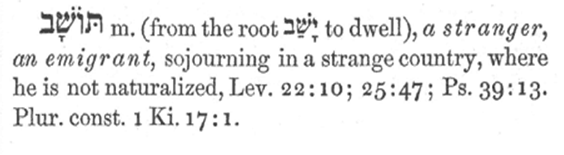 Of the 14 times this word ‘towshab’ is used in the OT, it is always translated sojourner, or stranger except with Elijah where it is translated as ‘inhabitant’.
 Renewed