Kings 19:4 “But he himself went a day’s journey into the wilderness and came and sat down under a broom tree; and he asked that he might die, saying, “It is enough; now, O Lord, take away my life; for I am no better than my fathers.”
Elijah is dejected – feeling a failure. He had failed his mission. Wasn’t he supposed to bring all Israel back to God? Didn’t the fire on Mt Carmel show who the one true God really was? And here he was, seemingly just one day later and Jezebel was after his blood. Where were all the people who had cried out “the Lord is our God’ [1 Kings 18:39]? Did they stand up to Jezebel? No. The prophet was now alone – and running for his life.
What did Elijah mean by “take away my life; I am not better than my fathers.” Perhaps he was referring to all the prophets who had died before him – and he was now asking God to take his life. He may as well be dead like them. But I don’t think so. I think that Elijah had a passion to be the one who would ‘turn the hearts of fathers to their children and the hearts of children to their fathers’. I think Elijah thought he was the chosen prophet to bring Israel back to God. All the other prophets had failed – but he would do it. And now, here he was, a failure just as the prophets before him were. He was feeling no better that his fathers, he may as well be dead.
And so Elijah comes to God and says ‘I am the only one, God – I am the only one left who loves you’. He knew that wasn’t true [1 Kings 18:4]. He knew there were others who were in love with the true God of Israel, but he was immersed in self-pity.
So, what does God say? God gives the best advice to a person feeling down in the dumps. A person feeling, ‘Oh poor me.’ [1 Kings 19:10]. Get up, dust yourself down, and get on with the next job I am going to give you. You’ve got more to do; you’re not finished yet!
So, God gives Elijah three more jobs to do –
“And the Lord said to him, “Go, return on your way to the wilderness of Damascus; and when you arrive, you shall anoint Haz′ael to be king over Syria; 16 and Jehu the son of Nimshi you shall anoint to be king over Israel; and Eli′sha the son of Shaphat of A′bel-meho′lah you shall anoint to be prophet in your place.” I Kings 19:15
Well, there you go. Lots more to do. But – was there something ominous in asking him to appoint a successor? Why? Was Elijah old and fading out? We have no evidence of that. Maybe there was a deeper lesson.
Of the three tasks, Elijah only completed one. He did anoint Elisha to be a prophet [1 Kings 19:19]. But God took him in the whirlwind of fire before he had a chance to do the other two jobs. Why? Why did God give him two jobs and then prevent him from doing them? Perhaps it was Elijah’s last lesson. Elijah – you have done your job – but my Spirit will not die with you. I will pass it onto others who will accomplish my will. One prophet may pass, but another will rise. The plan and purpose of God is not thwarted – it will pass from one prophet to another until it comes to The Son of Man. One of the sons of the prophets anointed Jehu [2 Kings 9:3], and then Elisha verbally anointed Hazael [2 Kings 8:13]. God’s plan is fulfilled by whichever vessel is used by the Spirit. So, Elijah’s last lesson may have been that he was a just a link in an ongoing chain.
So now, from 1 Kings 19, Elijah and Elisha go on together as a sort of ‘master and apprentice’. Or so it seems. In 1 Kings 21 Elijah seems to be alone in condemning Ahab over Naboth’s vineyard. Elijah continues alone in the 2 Kings 1 condemnation of Ahaziah. They seem to re-unite in 2 Kings 2 when Elijah is taken, and Elisha is granted a double portion of the spirit of Elijah.
Here, Elijah is taken in a whirlwind and the two prophets are separated by horses and chariots of fire. Elisha calls out
“My father, my father! the chariots of Israel and its horsemen!” [2 Kings 2:12].
This was a testimony to Elijah, not a description of the vision. It was Elijah who was the chariot of Israel – its strength as he was the vessel of God’s spirit. This was an epithet which Elisha himself was to inherit [2 Kings 13:14].
So, Elisha now emerges as the greater of the two. Elisha is recorded to have done about sixteen miracles to Elijah’s eight. Significant? Probably. Elisha now has a double portion of Elijah’s spirit. We are now connected to one of the greatest forerunners of Jesus.
Many of the miracles of Elisha are pointing us to Jesus –

So, we have Elisha as a powerful symbol of Christ. What of Elijah – what did he symbolise? He was the forerunner of Elisha, so he must represent the forerunner of Jesus, John the Baptist. The Jews saw a great mystique surrounding Elijah. Firstly, he seems to have escaped normal death, and his grave was never found. Another link with Moses. Also, the last message of God to the Jews before Christ alluded to a mysterious ‘Elijah’ who would herald the coming messiah –
“Behold, I will send you Eli′jah the prophet before the great and terrible day of the Lord comes. 6 And he will turn the hearts of fathers to their children and the hearts of children to their fathers…” Malachi 4:5-6
So, when John revealed himself to the people, the Jews naturally asked if he was Elijah.
“And they asked him, “What then? Are you Elijah?” He said, “I am not.” John 1:21
John denied that he was the literal Elijah returned from heaven, and yet the angel of the Lord had promised that John would go in the spirit and power of Elijah and fulfill the Malachi promise [Malachi 4:5-6] –
“And he will go on before the Lord, in the spirit and power of Elijah, to turn the hearts of the parents to their children and the disobedient to the wisdom of the righteous—to make ready a people prepared for the Lord.” Luke 1:17
So, surely John identified himself as the spirit of Elijah but not the literal prophet. Jesus identified John as the spiritual Elijah.
“The disciples asked him, “Why then do the teachers of the law say that Elijah must come first?” 11 Jesus replied, “To be sure, Elijah comes and will restore all things. 12 But I tell you, Elijah has already come, and they did not recognize him, but have done to him everything they wished. … 13 Then the disciples understood that he was talking to them about John the Baptist.” Matthew 17:10
Just as Elijah had anointed Elisha as prophet, it was John who baptised Jesus and enabled His anointing –
“Then Jesus came from Galilee to the Jordan to be baptized by John….16 As soon as Jesus was baptized, he went up out of the water. At that moment heaven was opened, and he saw the Spirit of God descending like a dove and alighting on him. 17 And a voice from heaven said, “This is my Son, whom I love; with him I am well pleased.” Matthew 3:13
When Elijah anointed Elisha, they went their separate ways and did not unite again until Elijah was to be taken. So, after Jesus’ baptism, John and Jesus worked separately. [John 4:1]. It was not until John’s imminent departure that they conversed again [Matthew 11:1-6]. Just like Elijah and Elisha. John knew his whirlwind and chariots of fire were coming for him –
“He must increase, but I must decrease.” John 3:30
How did john know this? How did he know that they could not co-exist? Because he recognised that they were Elijah and Elisha – and Elisha’s mission was to start only after Elijah had been taken.
See also: Elijah Was a Gentile
Moses & Elijah – The Earthquake, Wind & Fire


 great God, mighty and awesome, who shows no partiality nor takes a bribe. He administers justice for the fatherless and the widow, and loves the stranger, giving him food and clothing. Therefore love the stranger, for you were strangers in the land of Egypt.” [Deut. 10:17]
 Here, we see a representation of the coming Kingdom [Matthew 16:27-28], with Jesus as King in glory, and the saints symbolised by two people.
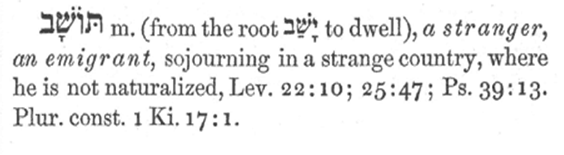 Of the 14 times this word ‘towshab’ is used in the OT, it is always translated sojourner, or stranger except with Elijah where it is translated as ‘inhabitant’.
 Renewed